What’s the Future of Salmon Fishing in California?
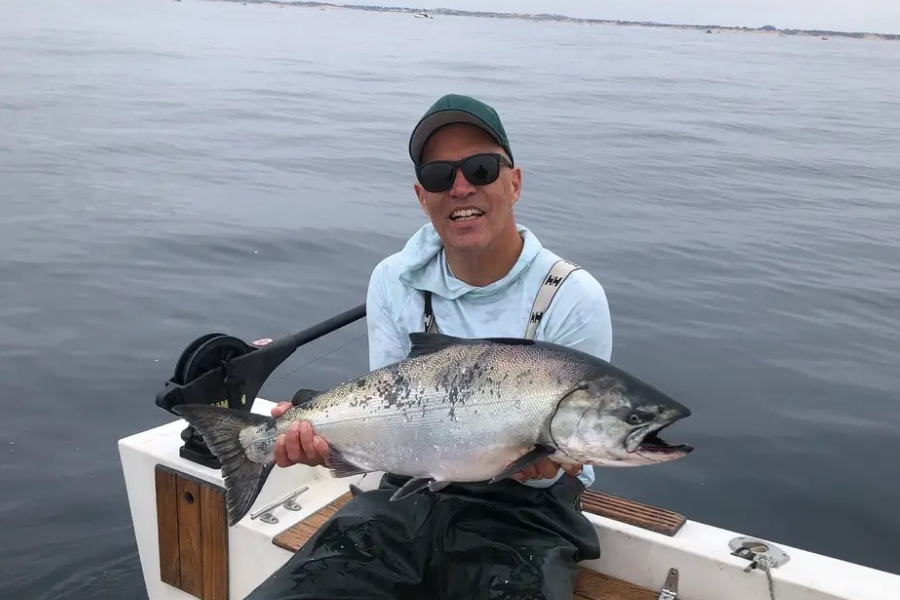
A California recreational salmon fisherman with his catch during the 2-day opener in June 2025. Photo credit: Reproduced with permission
The collapse of California’s Chinook salmon fisheries reached a new low in April when the Pacific Fishery Management Council recommended the complete closure of the commercial salmon season for the third straight year in a row. The recreational salmon fishing season consisted of just two chaotic days of recreational fishing in June, and then a final four days in September that quickly reached the limit for the season to close. Pretty good fishing if you didn’t blink.
What can we now say about the state of the rivers that support these fisheries and their potential for recovery?
First, let’s focus on the positive— Salmon populations are resilient!! They will rebound if they have cold water in their rivers when they need it. California salmon populations and fisheries were devastated during the recent 2012-2016 and 2020-2022 drought cycles, when cold water in Central Valley rivers was made scarce by the combination of dry conditions and extremely poor water management decisions. Early indications point to much improved survival in many salmon populations for juveniles that started life in Central Valley and coastal rivers during the wet winter of 2023 – flows that could be diverted in future if the Newsom and Trump Administrations have their way.
Nonetheless, the long-term decline of California salmon is clear, and despite extensive research on many potential causes, including changing ocean conditions, diet shifts that led to nutrient deficiencies and egg death, introduced predators, and more, one BIG problem is driving it:
“They need cold water when they are in the river, and they are not getting this. This has pummeled all the populations. The lack of cold water affects all of their life stages” said a federal scientist with California salmon expertise.
[Actually, TWO big problems, since the federal scientist who said this is currently furloughed, joining many others who have been laid off, fired, or taken early retirement under the new federal regime, and leaving the work of federal science management undone].
Governor Newsom’s water priorities would exacerbate the problem, like his efforts to fast-track projects like the proposed Delta Tunnel and Sites Reservoir projects, which would capture more river flows and then export them south of the Delta. These projects would only be possible if the rules protecting water quality and the environment are relaxed, which is where the backroom ‘Voluntary Agreements’ (VAs) come in. The VAs swap ‘habitat improvements’ for any real new limits on pumping more water. We love habitat! But, without adequate flows, all the restored ‘habitat’ in the world won’t help salmon survive long enough to see another fisherman’s hook, let alone return to spawn—water IS their habitat. Meanwhile, President Trump’s executive orders to maximize water deliveries to federal Central Valley Project contractors will also incentivize new policies and projects to divert even more water, further eating into the remnant flows that are (barely) keeping the salmon runs alive so far.
Salmon have surely suffered from a multitude of impacts on our river systems, dating from the European colonization of California. However, the continuous, ongoing, and growing pumping and overuse of water, largely for irrigated agriculture, has been the primary driver of their continued suffering. The present shutdown of the CA salmon fishery, which has devastated the commercial fishing fleet, is the culmination of a decades-long decline in salmon populations driven by a century-long regime of mismanagement.
Graphic showing decline of Chinook since 1955:
Friends of the River is working to protect California’s rivers, and all the species that inhabit them, including salmon. Here are three big things FOR thinks are needed to restore salmon fisheries:
Flow. First and foremost, California must establish strong new requirements for river flows on salmonid-bearing streams and protect those flows on their journey to the ocean. This means adopting – and implementing – science-based regulations under the state and federal Clean Water and Endangered Species Acts that require flows which consistently achieve the conditions needed for successful spawning, rearing and migration, and limit diversions and exports to levels that do not impact those life history stages – which is why FOR has been so deeply involved in working to secure new water quality and endangered species protections.
Promising new research supports the extensive scientific record in finding that by better shaping the patterns, volumes and duration of flow releases, we can dramatically improve the growth, survival, and number of successfully out-migrating juvenile and returning adult salmon. Such ‘facilitated migration’ fits into the broader theme of the Environmental Flows Framework, managing for ecologically functional flows that are needed to restore and protect freshwater ecosystems and the services they provide in our highly managed watersheds. However, it is important to note that this flow shaping must be done to benefit the entire aquatic ecosystem, not just salmonid species.
The science also says that by taking too much water out of the system and distorting seasonal flow and water temperature patterns, we are tipping the scales in favor of the introduced predators that contribute to the high mortality of juvenile salmon and steelhead. Higher and cooler flows help young salmon safely navigate to the ocean.
Habitat access. Salmon can’t always follow the flow to access their historic cold water spawning habitats if dams and other barriers to fish passage block their way. But change is in the air. FOR is leading efforts to implement our San Joaquin River Restoration Settlement Agreement, restoring both flows and spring-run Chinook salmon to once dewatered stretches of the mainstem river below Friant Dam.
And with the spectacular success of the recent dam removals on the Klamath River, other dam removal and fish passage projects are gaining traction—Recent agency-tribal partnership efforts show promise in restoring winter-run Chinook salmon to their ancestral home, the McCloud River above Shasta Dam. FOR is supporting similar projects to reintroduce salmon above dams on the Feather, Yuba, and other rivers that offer a promising alternative to hatchery production, freeing the adult salmon and steelhead to spawn naturally, and giving their offspring a fighting chance to migrate downstream and live as wild fish.
Sustainable water use: Simply put, we use far more water than is sustainable in our semi-desert state. On paper, water users have the right to use as much as five times as much water as actually exists, diversions along most rivers take more than half of the water, and some places like the lower Kern River and Tulare Lake are bone-dry except in exceptional flood years.
Sustainable water use relies on being honest about the hidden costs of traditional water management on communities (like the salmon fishing community), ratepayers, and ecosystems; promoting alternative approaches that are focused on highly efficient water use practices and foster local self-reliance; and factoring in resilience to climate change in how we manage our water supplies. FOR’s efforts to oppose expensive boondoggles like the Delta Tunnel and Sites Reservoir have in part involved documenting how cost-effective and more environmentally friendly alternatives are available for building such projects.