Louvers, and Pumps, and Predators, Oh My!
Fish Over People — Friends of the River is fighting back against Executive Order 14181, which would weaken environmental protections and push more water exports at the expense of rivers, fish, and communities.
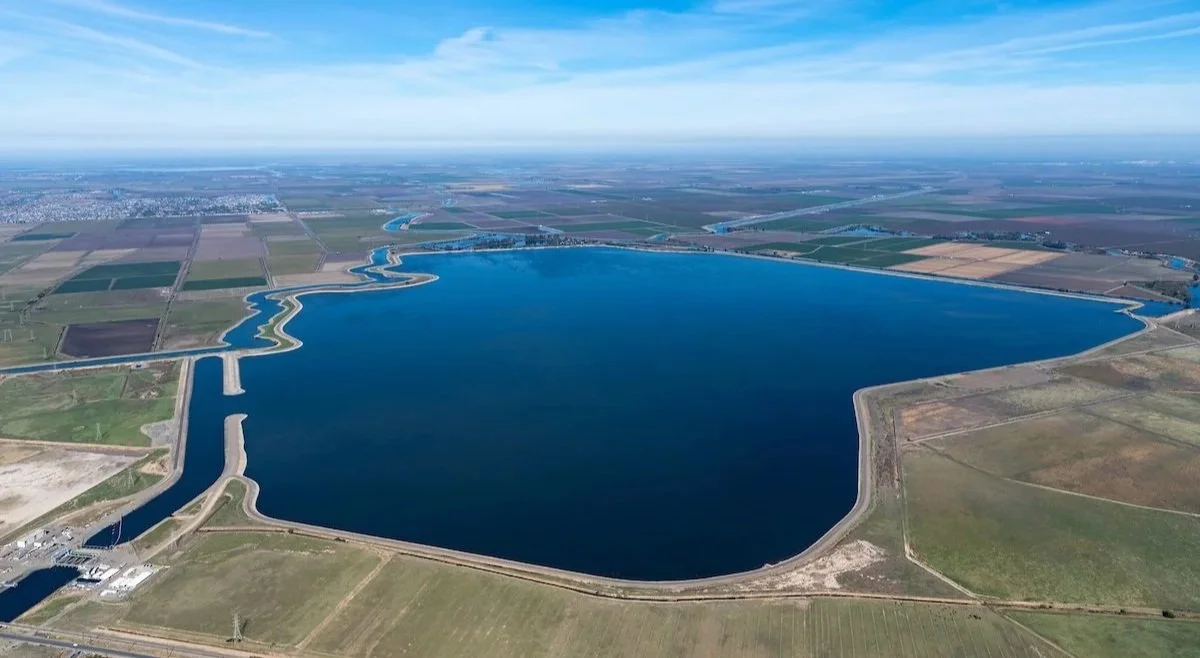
Clifton Court Forebay, the final destination for water before being sucked out of the Delta by the State’s massive pumps. Credit K. James, CA Dept. of Water Resources
By Devon Pearse, FOR’s Lead Scientist
I 💙 California
You may love her rivers, mountains, and lakes, but these days the beating heart that keeps California’s water moving is not a natural feature—it is the South Delta Pumps, the massive movers of water for the federal Central Valley Project (CVP) and State Water Project (SWP). First shocked to life more than a half century ago, these monsters of engineering supply water to the dry and dusty lands of the Central Valley agricultural empires through the arteries of the Delta-Mendota Canal and California Aqueduct, with smaller capillaries extending into the urban depths of the Los Angeles basin.
Determining the amount of water that gets pumped from the Delta to San Joaquin Valley agribusinesses and Southern California cities—as opposed to what goes all the way to San Francisco Bay and beyond—is contentious in the best of times. Now, a year into the Trump administration, the Bureau of Reclamation (Reclamation) has laid out its plan to “maximize the water pumping while maintaining protections for endangered fish species.”(1)(2)
But do we really believe protecting endangered species is their goal?!?
Known as ‘Action 5’, the newly released plan is a response of sorts to the demands President Trump laid out in Executive Order 14181 and the Presidential Memo ‘Putting People Over Fish’. There’s little connection to reality in these documents, which also claim that pumping more water from the Delta to southern California would have helped fight the Los Angeles wildfires in January 2025 – despite all the evidence to the contrary.
The executive order directs the Departments of Interior and Commerce to “immediately take actions to override existing activities that unduly burden efforts to maximize water deliveries” and to “operate the CVP to deliver more water and produce additional hydropower.” While Reclamation gears up to pump more water and blow off its environmental obligations, State water managers are scrambling to figure out how the changes on the federal side will impact operation of the State Water Project.
Action 5 describes the way in which more water will be exported from the Delta regardless of the impacts to Delta water quality or violations of previously agreed-upon environmental metrics like flow and salinity thresholds. Key operational changes include more backwards flows in the Old and Middle Rivers (both located in the southern part of the Delta near the pumps), elimination of water release actions (flow requirements) that maintain critical delta habitat in summer and fall, removal of even the minimal measure to reduce water export- under the Voluntary Agreements. (The VAs are a regulation scheme being pushed by the Newsom Administration, where regulates have negotiated a path to regulate themselves—read more about the VAs in our most recent article).
The CVP/SWP water pumping facilities—Running Rivers Uphill and Backwards
Before we dive in any deeper, let’s get our heads wrapped around one thing: In the backwards world of California water exports, flows in the parts of the Delta river system near the pumps are judged by how backwards they flow. In other words, when the federal and state pumps are operating they can make the Old and Middle San Joaquin River channels flow away from the ocean at 5,000 cubic feet per second or more.
Just imagine how confusing this is for a baby salmon! One minute they are swimming downstream, heading towards the ocean, and the next—still following the downstream flow—they are drawn deep into the Delta and towards the pumping facilities. Then, if they are lucky, they will evade being eaten by predatory fish or birds and end up ‘salvaged’: directed by louvered screens into a trap instead of being sucked into the pumps, and driven in a water tanker truck safely downstream, hopefully to complete their migration to the ocean.
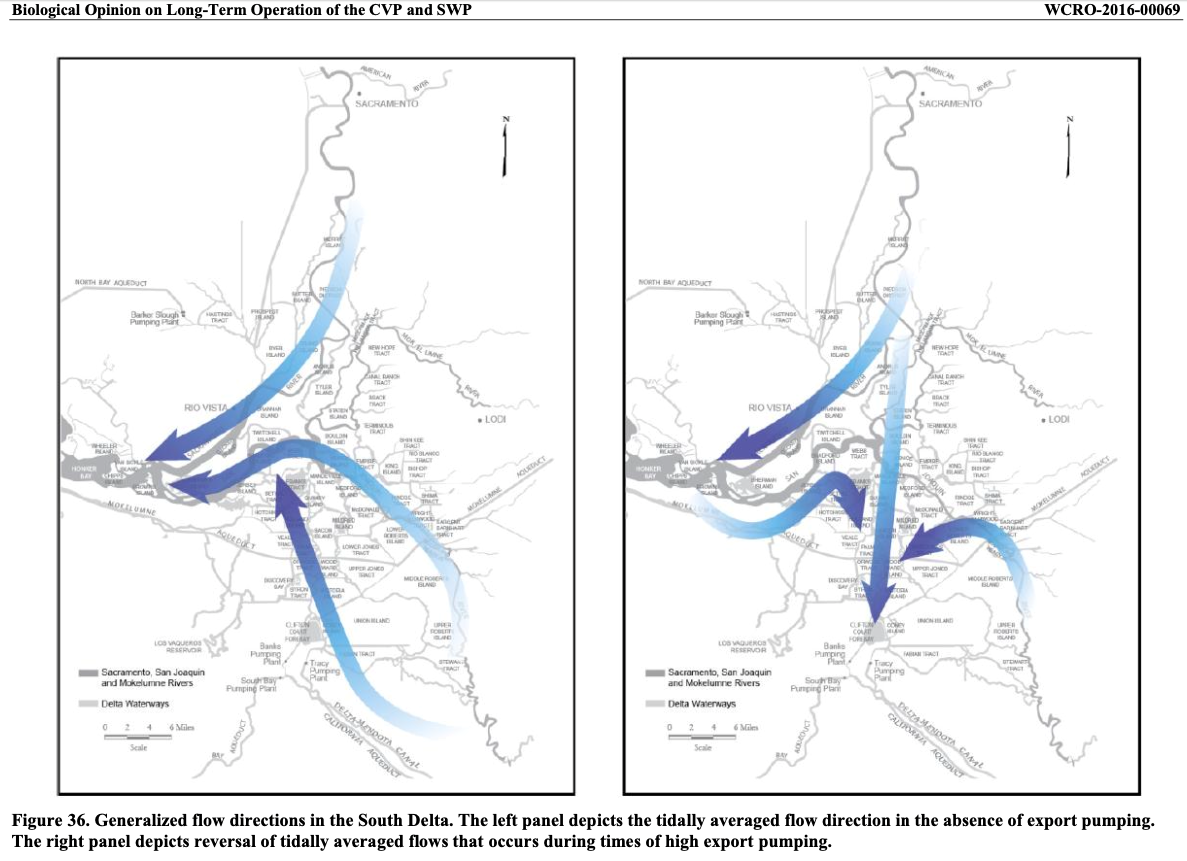
Figure showing flow direction in the South Delta. Credit: the Biological Opinion on the Long Term Operation of the Central Valley Project and State Water Project.
Water Exports are Not the Only Problem for Fish
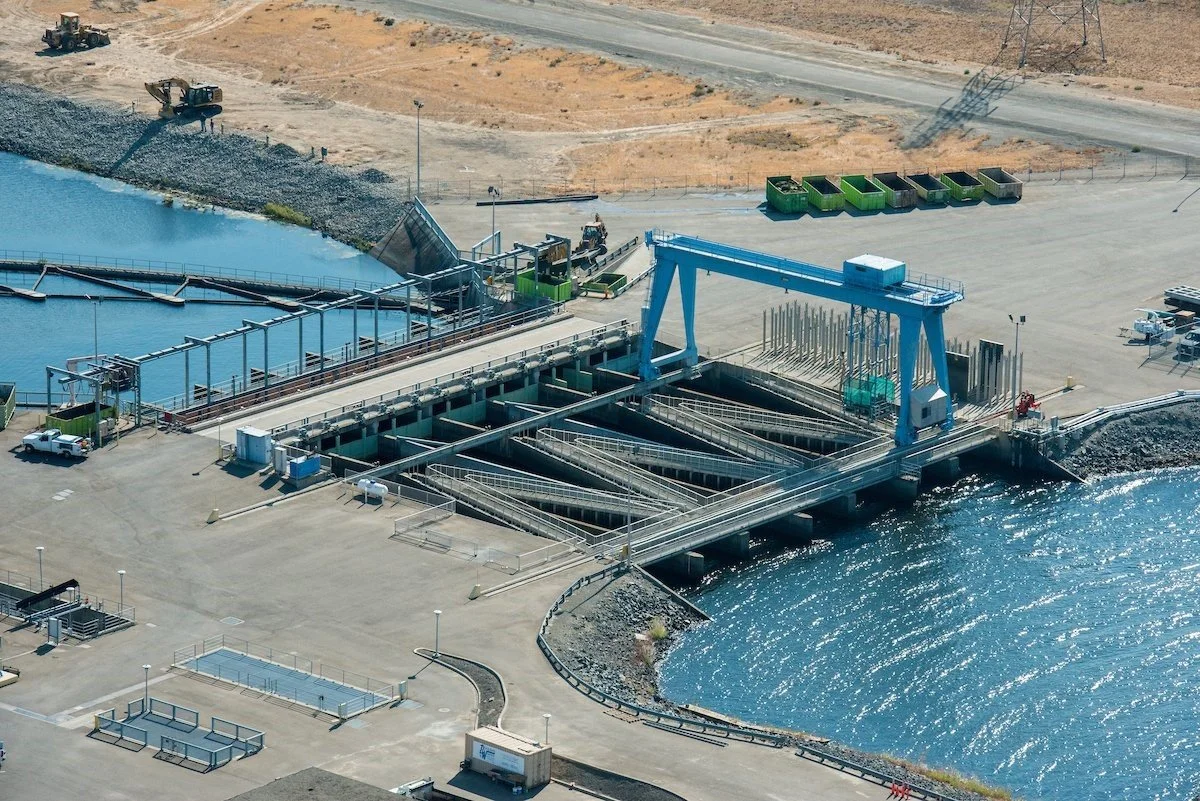
State Water Project fish screens
Proponents of increased water extraction often point out that reduced flows in the rivers and delta are not the only thing harming native fish species. But the best available science is unambiguous—flow is the master variable that impacts watershed health. When flows in the rivers are adequate, temperatures are maintained, juvenile salmon have increased migratory success, and predators have a harder time catching them.
Fish are Not the Only Limiting Factor for Water Exports
In fact, a large proportion of the time the ‘controlling factor’ that limits CVP/SWP water export rates is the need to maintain the freshwater quality in the Delta for human use. In other words, we are often pulling so much water from the system that we can’t pull more out without taking from ourselves. For example, excessive pumping could pull saltwater further inland, which would damage drinking water quality.
While it is already clear that Action 5 is bad for fish, Reclamation’s own “Fact Sheet”(3) explicitly states that Reclamation plans to further modify the way it operates the Central Valley Project to maximize water exports to the South regardless of whether they “fall outside of the bounds of the current Endangered Species Act and National Environmental Policy Act.”
FOR is keeping an eye on Reclamation’s implementation of Action 5 and will alert the public and decision-makers about the likely unwelcome consequences, and consider what other actions need to be taken to fight back. Stay Tuned!
Resources:
(1) Reclamation press release about maximizing water supply
(2) LA Times article about Trump administration’s plans to pump more water, Dec 4, 2025