Voices from the Past: California Water Plan since 1957
The 1970s were pivotal years for river conservation in California. That is when the state’s plans, then most recently embodied in the 1957 California Water Plan, to convert great lengths of its rivers into reservoirs clashed with financial realities and the environmental consequences to the state.
The original 1957 California Water Plan was the fruit of a half century of engineers’ dreams to plumb California well enough that the state’s waters could be prevented from being “wasted to the sea.” Instead the captured waters would be delivered to the arid regions of the state to make the deserts bloom.
That’s why I jumped at the chance to paw through and help sort the Save the American River Association’s boxed records. I was not disappointed. But a September 1, 1970, Sacramento Bee story especially stood out: the title, “Reagan Administration Puts 10 Conditions to Supporting East Side Canal.”
If you are confused, yes, the U.S. Bureau of Reclamation’s “East Side Canal” only exists today in small pieces: the Folsom-South Canal (from “Lake” Natoma on the American River to the Sacramento Municipal Utility District’s closed nuclear power plant near the Cosumnes River) and a short reach of canal heading north from the Stanislaus River. But back in the day the East Side Canal was to be a grand affair winding its way along the “toe-hills” of the Sierra Nevada from the proposed Auburn and Coloma dams on American River upstream of Sacramento to the City of Tulare or even south of Bakersfield.
Married up with the never-constructed North and South Yuba Canals emerging from the never-built giant Marysville Dam on the Yuba River and a never-built canal from the Sacramento River, the East Side Canal was designed to carry as much as 7,000 cfs south, rivaling the big state and federal canals already snaking along the west side of the San Joaquin Valley.
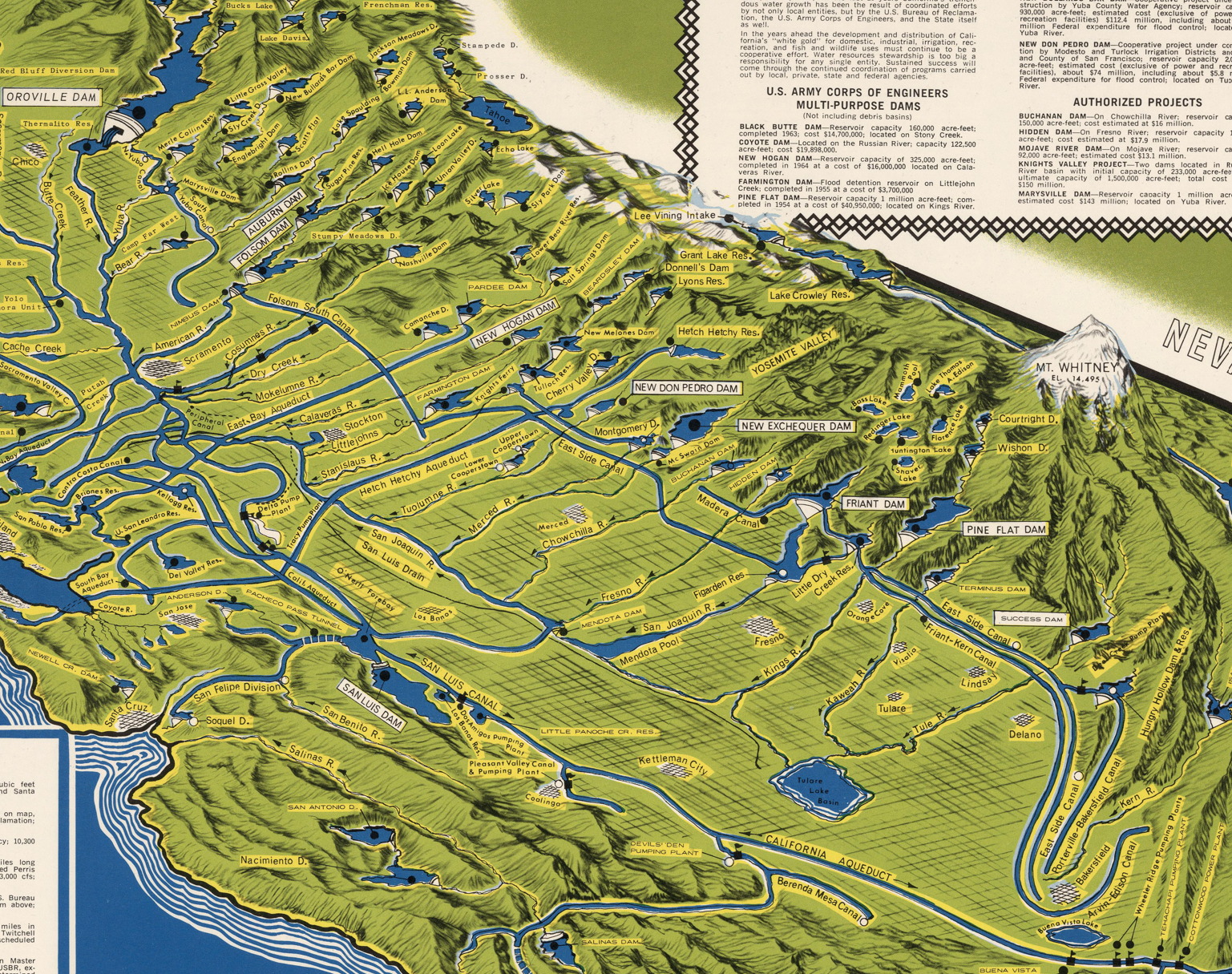
Never built canals along the east side of the Central Valley (excluding Friant-Kern and Friant-Madera, which were built). Credit: Irrigation Districts Association of California, 1968.
These canals, including the already constructed big canals from Reclamation’s Friant Dam on the San Joaquin River and the never constructed Mid-Valley Canal, were planned to augment the supply of the already well-watered east side of the Sacramento and San Joaquin Valleys.
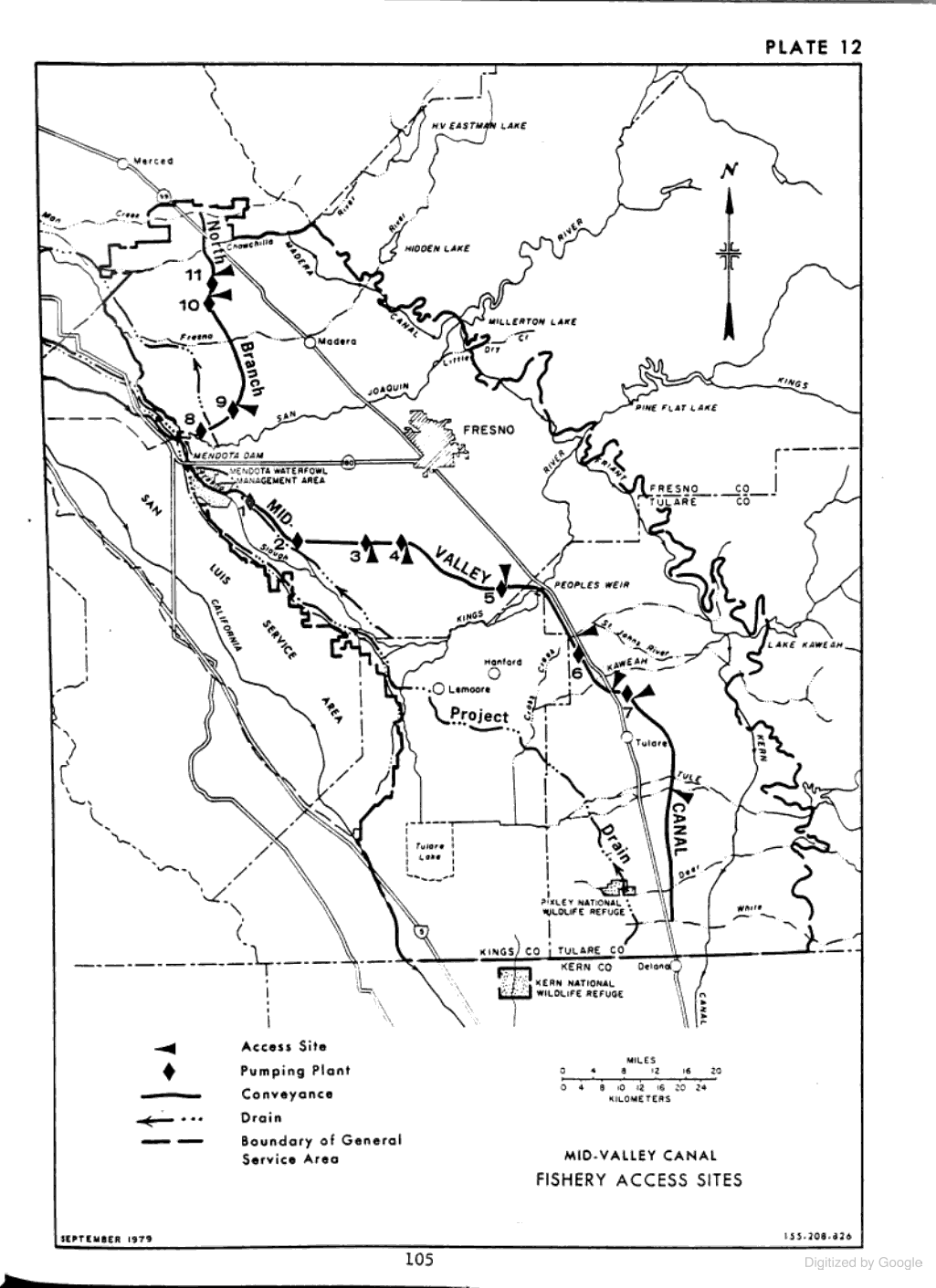
Mid Valley canal. Credit: USBR, 1980.
But the Bee story hinted that there was trouble in Paradise. Ronald Reagan’s cabinet-level Resources Agency Secretary “Ike” Livermore was publicly doubting if another 1.5 million acre-feet of water could be squeezed out of Sierran rivers without damaging at least the lower American River and the San Joaquin/Sacramento/San Francisco Bay Delta.
He worried that the “Master Drain” for then newly watered and previously dry-farmed lands in the west-side of Fresno and Merced Counties had not been built (and even today has not). Ironically, these often drainage-impaired and corporate farmlands lands and the State Water Project would in a few short years out compete the East Side Canal boosters for scarce Delta water. (Today, the westside farmers are instead fallowing their irrigation-water-soaked lowlands and moving the crops to higher better-drained ground — at least where they can.)
Livermore also noted that the irrigation customers (Reclamation’s largest share of contractors) wouldn’t be able to pay for the project without considerable subsidies. Ike also reminded Nixon’s Secretary of the Interior Wally Hickel that (like the recent draft water right order for the proposed Sites Reservoir project) Reclamation’s projects were subject to reduced water availability by future uses in the “areas of origin,” and future federal authorizations should continue that feature.
Reading that newsclip only emphasized that the realities of the past go on to appear in the present as well. Clearly, more than a half century ago, Livermore nailed it and nailed it for today as well. The only major issues he missed were the next half century of growing unsustainable increases of land in production and the impacts of climate change that has been increasing per-acre crop demand and making generous runoff a chancy thing.
Not a bad analysis for a half century ago, though.
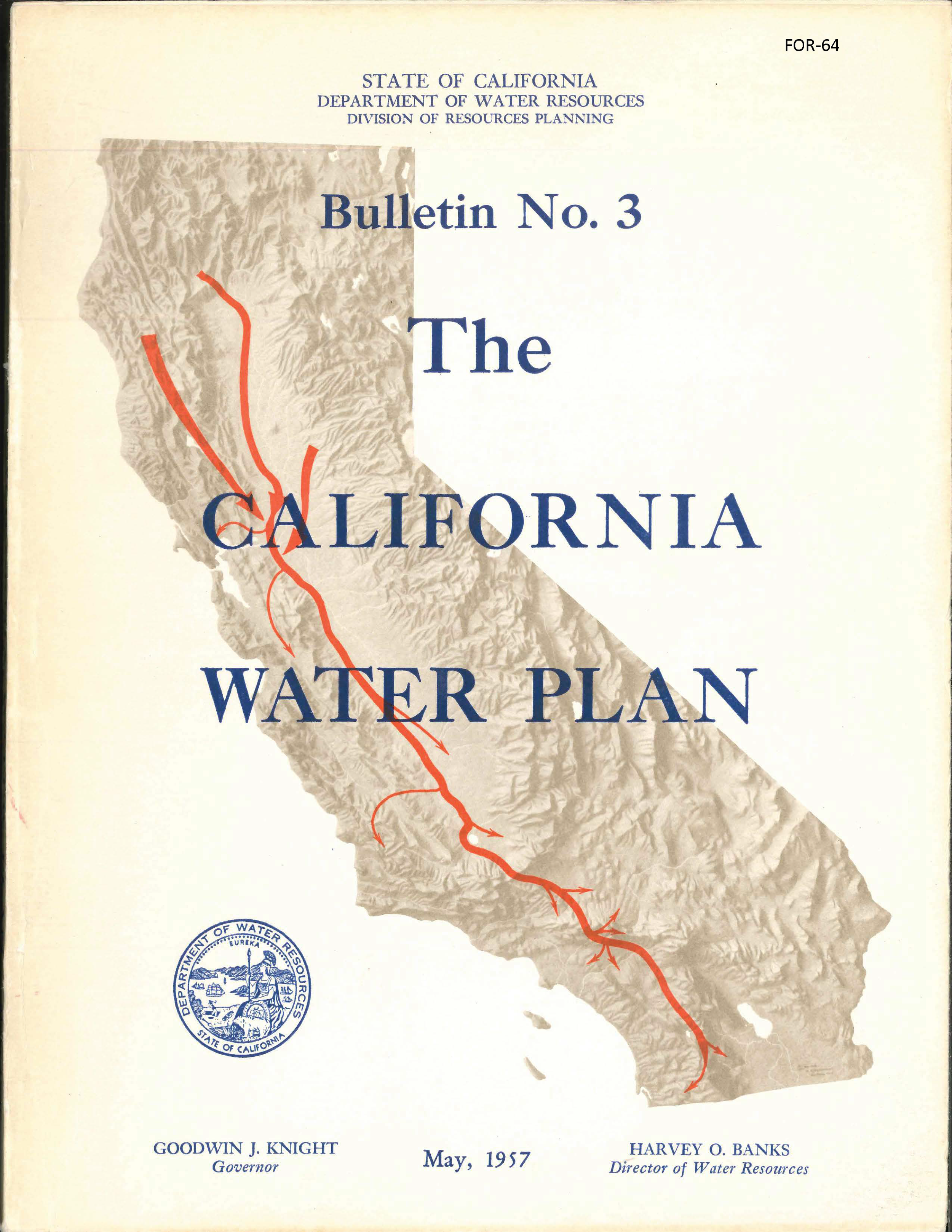
The original 1957 California Water Plan was the fruit of a half century of engineers’ dreams to plumb California well enough that the state’s waters could be prevented from being “wasted to the sea.” Instead the captured waters would be delivered to the arid regions of the state to make the deserts bloom.
The 1957 California Water Plan featured extensive maps of rivers to be tamed and considerable discussion on just what dams, canals, pumps, siphons, and tunnels would be required and for what purposes they would serve. Subsequent five-year Water Plan updates tended to be less bold and specific. However, with the passage of State Senator Anna Caballero’s SB 72, we may be headed back to the mid-twentieth century again.

State Senator Anna Caballero
The new California Water Plans will have an interim goal of getting 9 million acre-feet annually of new statewide water supply — or water storage, water reclamation, conservation, or desalination. For good or ill, the mix is not specified.
To the extent that new water is the goal, that could prove to be quite a challenge for a state that already uses 42-million acre-feet annually and is already experiencing the law of diminishing returns. Dams just aren’t as “productive” when the rivers they lie astride are already well-tapped.
After all, the West’s mightiest river the Colorado, essentially no longer “wastes” into the Gulf of California (see next article). Watersheds in the south and north state are becoming less productive. The states of Oregon and Washington and the country’s candidate 51st state (Canada) are objecting to California capturing the Columbia River. Most of the state’s aquifers are already overtapped — as are many of the state’s rivers. Yes, the “easy pickings” aren’t available anymore — for a million acre-feet or nine million.
If the new California Water Plan returns to a 1957 mindset, it will be doomed to failure. If California’s planners see that successful water management will necessarily feature water reuse and recycling and demand management — and probably some desalination and water cleanup — the California Water Plans of the future will be relevant. It will be up to the state’s citizens and its leaders to choose the right path.
Good times on the Colorado River are ending
No, I am not talking about a successful Grand Canyon trip. I’m talking about dividing up its waters. The sum of the division of the Colorado River’s waters exceeds what nature has been providing, something that has been apparent for decades.
But soon the multi-year storage in the huge Grand Canyon reservoirs will be reaching the point where water deliveries will have to be seriously curtailed. The multi-year/decade west-wide drought is finally biting. And climatologists like Dr. Daniel Swain, our 2026 California River Awards honoree, aren’t predicting a rosy future.
The problem of course, is how the shortage will be allocated. In other words, who is going to get less water and how much less. Those decisions may be arrived at by the water users. More likely they will be political or argued over by lawyers in front of judges.
Hold on tight, there will be rapids ahead. Whether there will be smooth paddling after that section will depend in large part on how much California and other states droughtproof their supplies through the aggressive adoption of water reuse, water recycling, demand management, land repurposing, and other tools (see previous article).