Balancing Groundwater Use in the Southern San Joaquin Valley Doesn’t Mean Drying Up Rivers
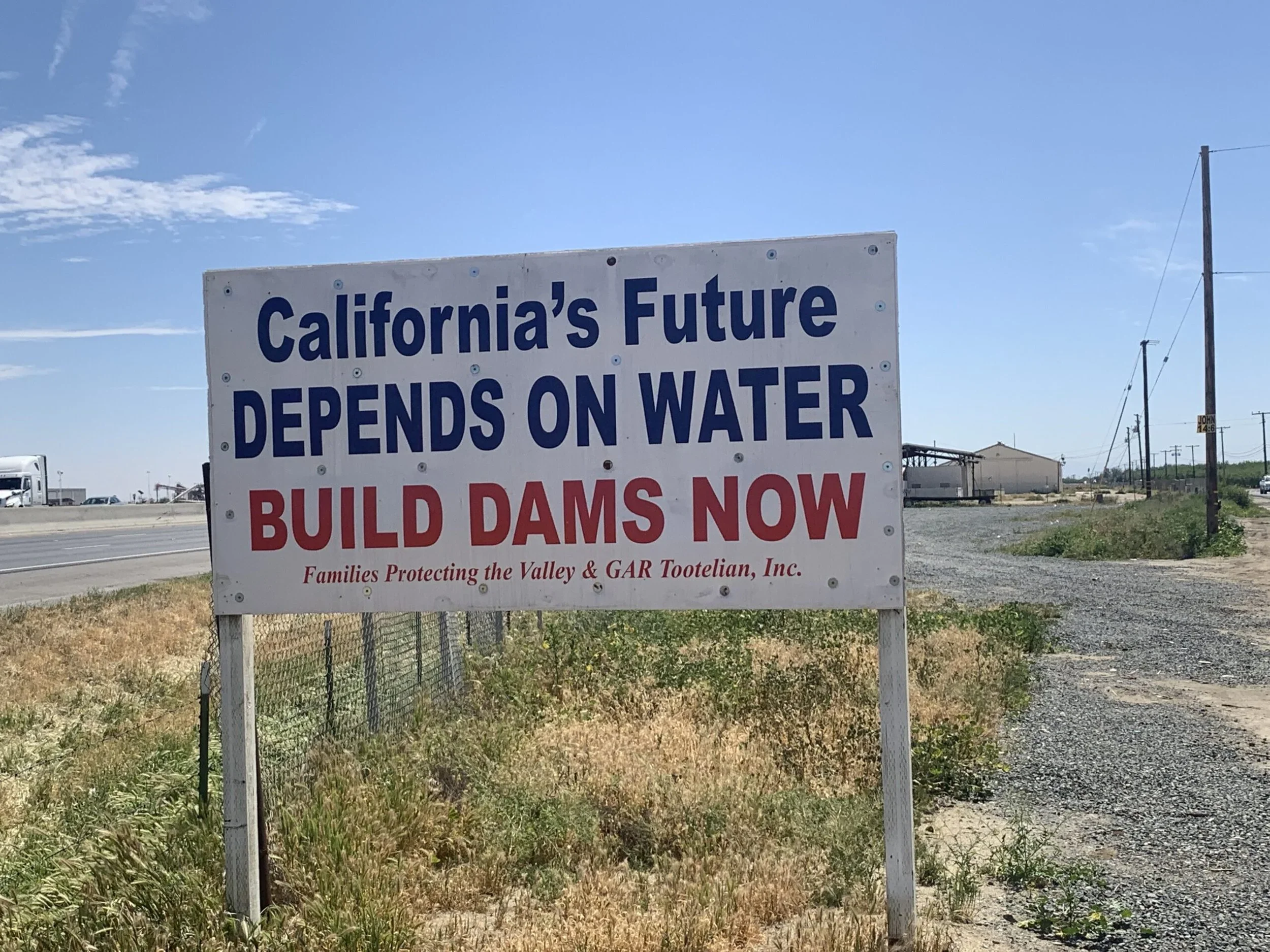
Roadway signs such as this exist along stretches of I-5 and Hwy 99 in the San Joaquin Valley.
Southern California and the neighboring Southwestern states have been overallocating water from the Colorado River for decades. And the day of reckoning for such an unsustainable approach to water management has finally arrived (see this month’s article on the Colorado River).
But there’s another seemingly endless supply that Californians have drawing down for more than a century — the aquifer underlying the San Joaquin Valley from Kern to Merced Counties(1). Reality, however delayed in its acknowledgement, finally intervened. After decades of delay, in 2014 the California legislature passed the Sustainable Groundwater Management Act (SGMA), requiring overlying groundwater pumpers in significantly overdrafted basins to bring their groundwater basins into balance (the standard is avoid “undesirable” results).
With two or three million acre-feet of average annual “overdraft,” that job is just as hard as bringing California’s Colorado River overuse into balance. Unfortunately, an unintended consequence of passing SGMA has been to motivate some water users to divert even more water from already overallocated surface water systems – rivers and streams, that is – in order to make up for their over-extraction of groundwater.
For instance, powerful water interests in the southern San Joaquin Valley are pushing the “Water Blueprint for the San Joaquin Valley,” which would rely of course on pumping more water from Northern California, and a lot of hot air is being mobilized by state and federal politicians to advance that plan. Winning their big prize (a lot more imported north state water instead of living within a sustainable water budget), so far, remains speculative.
The Valley elites have achieved some success in persuading elected officials to provide them with the gift of taxpayer funding for the rehabilitation of large area canals. The likely billion-dollar expansion of San Luis Reservoir (which may provide about one hundredth of the “needed” extra water if it all went to the San Joaquin Valley) can also be counted among their successes. But they have a long way to go and many rivers to damage in their way.
But the timelines of SGMA are finally beginning to bite, and so far the speculative supply-side “solutions” to using too much groundwater are not cutting it with the SGMA regulators. Reducing demand on groundwater is looking more and more real.
With the overdraft around 20% of the south Valley’s water use, fallowing a million acres could be on the near-term horizon. So how does one do that? Solar photovoltaic “farms” are already being implemented. Conversions of farmland to other non-water-intensive uses are being contemplated. Farming with less water-intensive crops, from winter small grains (think wheat and barley) to very low water-use perennial crops will also be part of the solution set(2).
Whatever the future brings, in the words of the famous physicist Richard Feynman, “…reality must take precedence over public relations, for Nature cannot be fooled.” What is unsustainable has to be fixed, and the south Valley will find itself no different.
Resources
(1) The Future of Agriculture in the San Joaquin Valley - PPIC
(2) Studies look at “less bad” options for farmers facing groundwater cutbacks – SJV Water