Keeping the Triple Threat at Bay
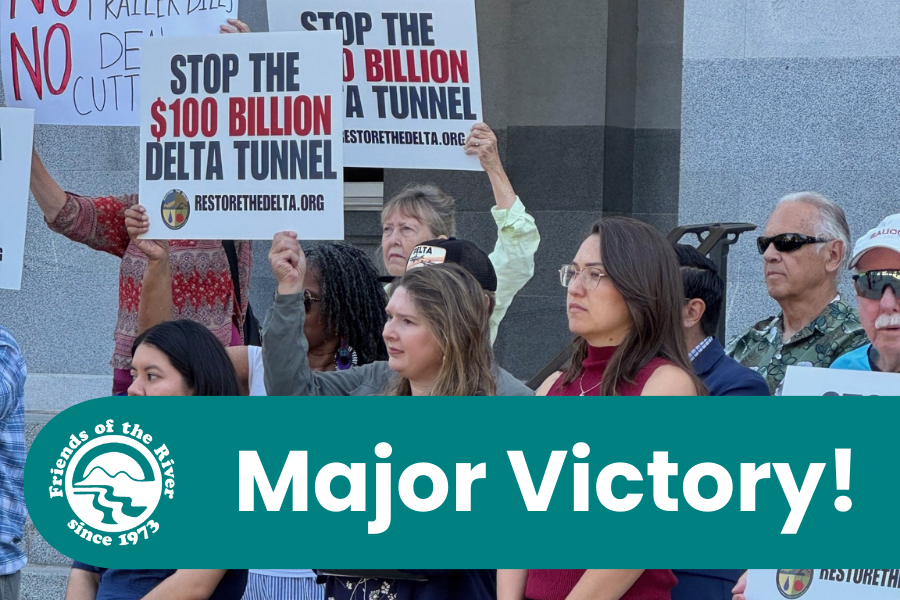
FOR Board Member, Ashley Overhouse and FOR Policy Director, Keiko Mertz, at center, attending the Rally for the Delta on Oct 5th, Photo Credit: Friends of the River
Rejection of governor’s attempt to fast-track bad projects resets push to gut new water quality protections.
California’s rivers received a respite in recent days, in two startling developments. First, last week the state legislature declined to include in the state budget Governor Newsom’s proposed trailer bills to limit public participation and fast-track permitting of the Delta Tunnel and of the so-called Voluntary Agreements between water districts and the Newsom administration that would weaken water quality standards (which together with the proposed Sites Reservoir constitute a “triple threat” to healthy rivers and the Bay-Delta estuary).
Second, as a result the State Water Board yesterday withdrew its revised draft of the long-overdue update of the Bay-Delta Water Quality Plan, in which it proposed to adopt the VAs that would utterly fail to improve flow conditions in the overstressed Bay-Delta estuary ecosystem – and even undermine existing levels of protection. These two developments were closely related.
Legislature Says No to Fast-Tracking
The argument against the trailer bills was summarized in an op-ed by FOR Program Director Gary Bobker and Delta farmer Tom Zuckerman that appeared on the widely read water website Maven’s Notebook and was distributed to legislators: ‘FATHER KNOWS BEST’ ISN’T A WATER POLICY FOR CALIFORNIA’S FUTURE.
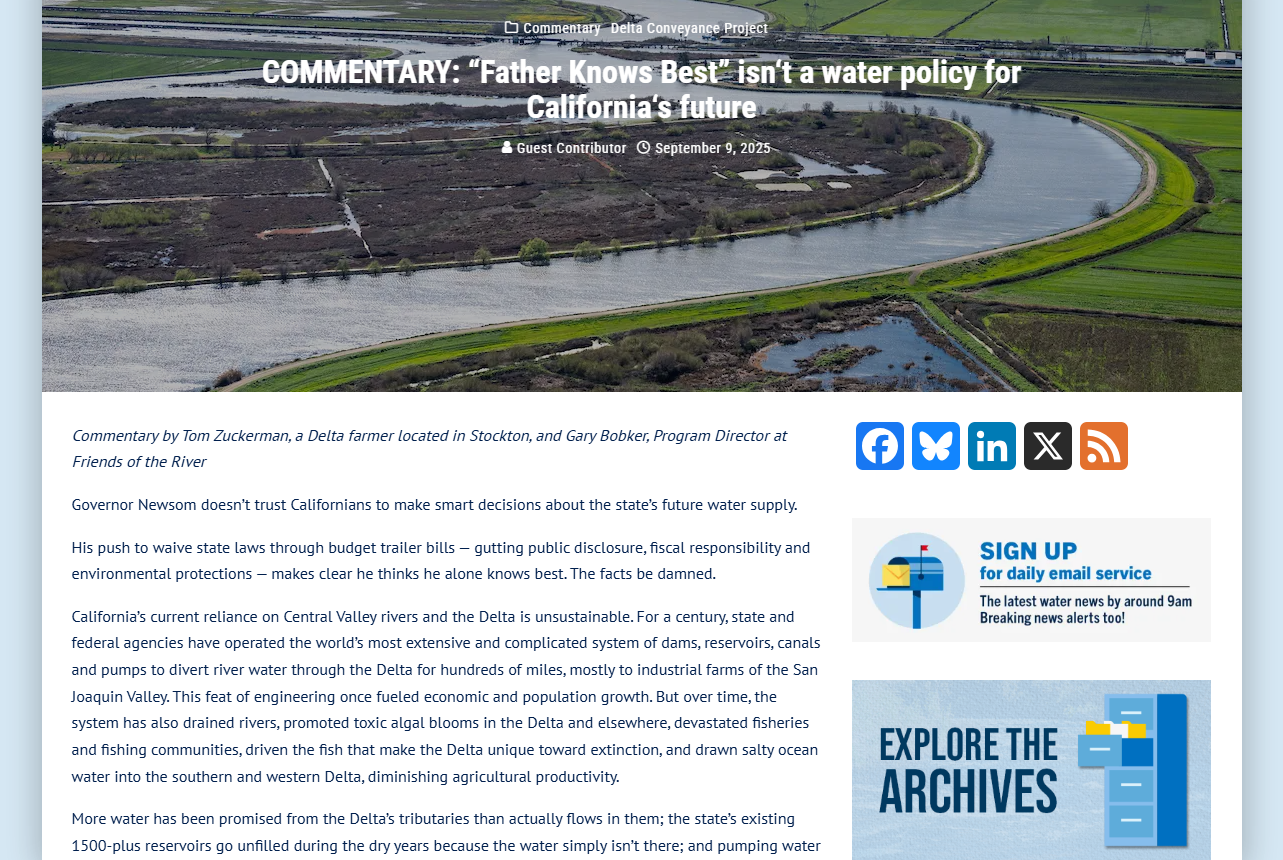
Maven’s Notebook - Commentary:
“Father Knows Best” isn‘t a water policy for California‘s future
A Broad Coalition Holds the Line
Despite strong pressure from the governor and water interests, leaders in both the Senate and Assembly, including Senate Pro Tem Mike McGuire, Speaker Robert Rivas, and Delta Caucus co-chairs Senator Jerry McNerney and Assemblywoman Lori Wilson, held firm and refused to allow the trailer bills to move forward. Advocates from a broad coalition of interests, including Restore the Delta, the Shingle Springs Band of Miwok Indians, Resource Renewal Institute, the Winnemem Wintu Tribe, Defenders of Wildlife, the California Water Impact Network, and the Sierra Club, deserve special recognition for their incredible efforts to educate legislators and organize the opposition. As well as FOR supporters who made their voices heard.
What’s Next for the Triple Threat
The legislature’s decision not to take up the trailer bills means for now that the Triple Threat projects will continue to be considered through the normal, public water quality and water rights proceedings being conducted by the State Water Board.
As the Board’s Administrative Hearing Officer nears a decision on the water rights application for the expensive and unnecessary Sites Reservoir, FOR and other protestants argued to keep the evidentiary record open to reflect important new information that the Sites proponents had not shared previously, including new estimates showing the reservoir’s costs ballooning to over $6 billion, the discovery of bald eagle nests not reported in the applicants’ wildlife surveys, and modeling results that had previously been requested by the protestants.
In the Delta Tunnel proceedings, FOR’s experts are scheduled to testify in September and October.
Environmental scientist Dr. Christina Swanson shows how the Department of Water Resources failed to accurately and adequately model potential climate change impacts on hydrology and biology or to evaluate the effectiveness – untested and unproven in the real world – of what would be the world’s largest fish screens.
FOR senior policy analyst Ron Stork explains how the Tunnel will incentivize further water development projects in the Central Valley and North Coast.
River recreation business owner Charlie Center reveals potential impacts of changed reservoir operations and increased water transfers on the ecological and economic health of local watersheds upstream of the Delta.
And Pacific Institute researcher Heather Cooley documents the potential for millions of acre-feet of water from conservation, recycling, stormwater capture and other approaches that could provide a more reliable and cost effective source of water supply for Southern California, instead of the expensive and harmful Tunnel.
Finally, FOR had been gearing up to submit extensive written comments and make panel presentations at the Board’s upcoming workshops on its revised draft of the Bay-Delta Water Quality Plan, making the case that large-scale improvements in freshwater flow from Central Valley rivers to the Delta and San Francisco Bay are needed to protect and restore river and estuary ecosystems and water quality. That’s why FOR opposes Voluntary Agreements that would maintain or even worsen the unsustainable status quo in which toxic algal blooms are proliferating, fisheries are closed, species are nearing extinction. But after the governor failed to secure a CEQA exemption for the Bay-Delta Plan, the Board announced yesterday that it was withdrawing the draft and would recirculate it later, cancelling the comment period and workshops. The fact is that the Voluntary Agreements, which would allow for increased diversion of freshwater flow by new projects like Sites and the Tunnel, can only move forward if environmental review requirements are weakened – so there’s hope that a fair evaluation will torpedo the VAs.
We should all celebrate these victories for full review of projects that will cause major environmental damage - and charge Californians for the privilege, to boot. But vetting all these projects the normal way may not last. Trailer bill supporters have vowed to push for their introduction and passage next year. It might be a while until the fat lady sings…