Silly Season in the CA Legislature
Photo Credit: Open Source
Back to the Future?
AB72: The California Water Plan is an institution in California. First published in 1957, it envisioned the massive conversions of entire river and stream systems — large and small — by dams and reservoirs to feed massive canals to export water to the “areas of deficiency” from the areas of “surplus.”
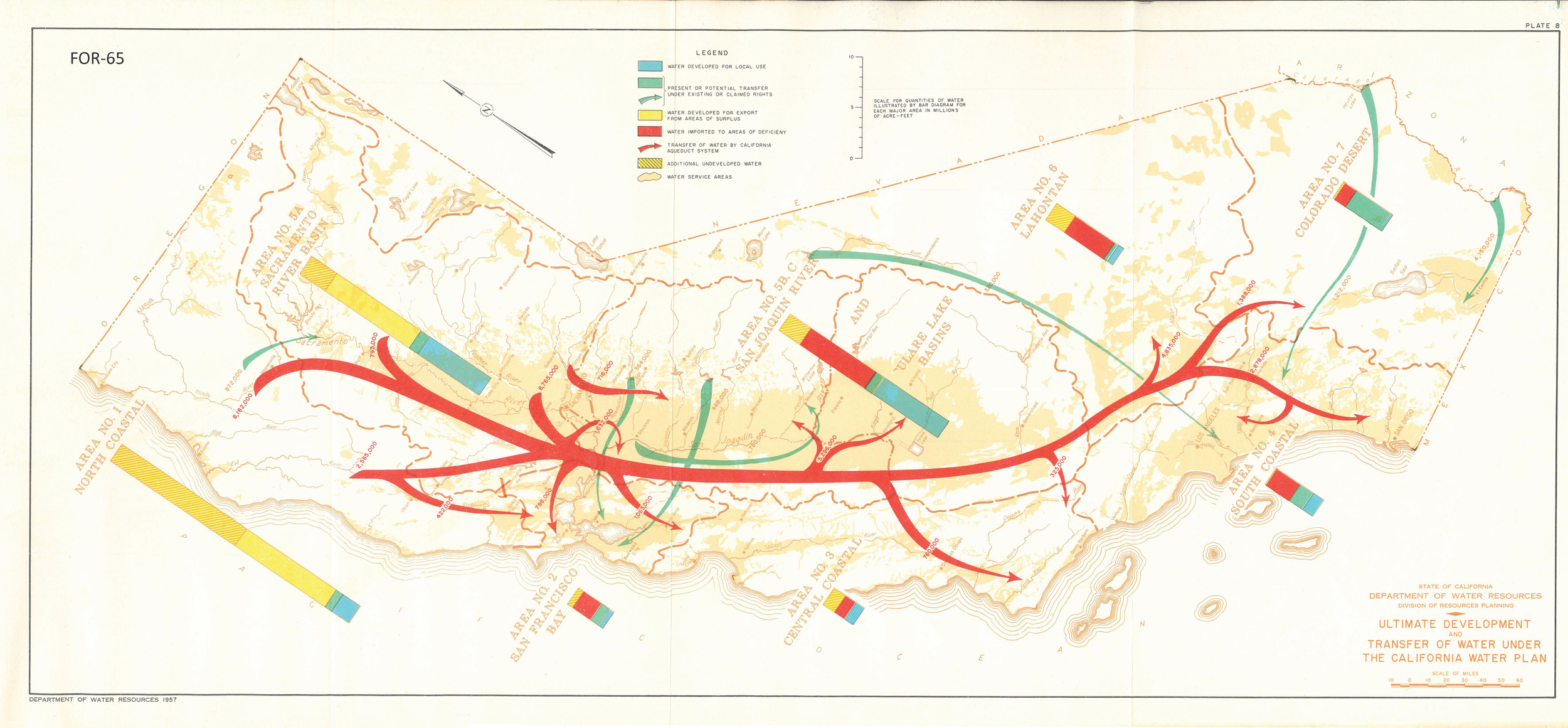
The final image from the 1957 California Water Plan, a graphical depiction of the thesis of that Plan: moving water to from the North to southern “areas of deficiency.”
The state only needed the will to implement and finance the engineers’ vision for the state.
Some of that original plan was implemented. Fortunately, some were not. The north coast rivers were protected by the California Wild & Scenic Rivers Act in 1972 (and still are), and some dams stumbled as construction was beginning (think Auburn dam on the NF American), and others never took flight (think the giant Coloma/Salmon Falls dam on the SF American where the water rights application was cancelled a few short years ago.) [FOR 2021 exhibit 16, SJ County water rights]
However, the state’s waterways have never proven to be safe from the now five-year updates (“Great Leaps Forward”?) of the Water Plan.
Enter State Senator Anna Caballero (DMerced, formerly Salinas). Her bill, SB72, in the process of recasting some of the goals and approaches of the upcoming Water Plans, includes this little target for the 2028 Plan: “the department [of water resources] shall include an interim planning target of 9,000,000 acre-feet of additional water, water conservation, or water storage capacity to be achieved by 2040.” And that’s just the interim target. No doubt larger targets may appear. (For context, state consumptive water use is around 40,000,000 acre-feet annually.)
The bill is agnostic on how to achieve these objectives or in sorting out the inconsistent metrics of how to do so. We do know that if the proposed SB72 goal was to be achieved by increased storage capacity, that would require the construction of the equivalent of 9 Folsom or Pine Flat Dams (the big ones on the American and Kings Rivers). And with state new storage capacity-to-yield ratios trending at 10 to 1, it would take 90 dams of this size to generate the water — assuming that surplus canyons could be found and this much water could still be squeezed out of them.
Of course, there are more productive strategies available (think water conservation and demand management), but the state’s engineers, responding to their inner engineers, and given these legislative instructions, may be tempted to revisit the visions of 1957.
Needless to say, the measure passed the 40-member state senate with 37 votes and no opposition votes. It has cleared its first Assembly policy committee unanimously, enhancing the gleam in the author’s eye of achieving final passage and signature by the Governor. It is currently being held (in the suspense file) in the Assembly appropriations committee, where it could pop out for floor action anytime. Its fate will rest on the common sense and water expertise of the California legislature.
This is a great example of bad water policy.
It's all about the Subsidies
ACA11: A key decision made by the California governors who created the State Water Project (SWP) back in the late 1950s and early 1960s was that the beneficiaries of the SWP would pay the state’s taxpayers back their investments. Although there have been and continues to be lapses in the performance of these commitments, the principle remains.

Credit: Open Source
And yes, the potential unavailability of free taxpayer subsidies has stymied many a project that would have otherwise beset our state’s rivers. Thanks especially are due to Governor Pat Brown and President Ronald Reagan for that one.
Enter California Assemblymembers Alexandra Macedo (RTulare) and Juan Alanis (RModesto). They are proposing a constitutional amendment to set aside 1% of the state’s general fund budget for water infrastructure projects. This year alone, that would be $2.229 billion dollars. Not chump change, and a gift to keep on giving every year!
And would that money be used by the state of California? Well, of course not. Instead, it would be handed out to public water, special districts, joint powers authorities, and public-private partnerships for their purposes. Some of these entities even have eminent domain power to dam your local rivers.
And don’t think that water districts don’t have ambitions. Just to pick two examples. (1) The Turlock and Modesto Irrigation Districts have roughly $4.8-billion dollars of ideas planned for the Tuolumne and Stanislaus River (in the case of the “T,” to own all of the river’s remaining unappropriated waters, and (2) The San Joaquin Valley Blueprint is planning to bring 9-million acre-feet of new water to the southern San Joaquin Valley. The Blueprint just needs other people’s money (and voters and public officials who don’t care about the rivers to be sacrificed).
Fortunately, this bill isn’t advancing very much (Republican authors). But don’t be surprised if someday when you go to a supermarket if you are accosted by signature gatherers to get a constitutional amendment like this one on a statewide ballot.