
Yuba Water Exports Harm Salmon and Steelhead
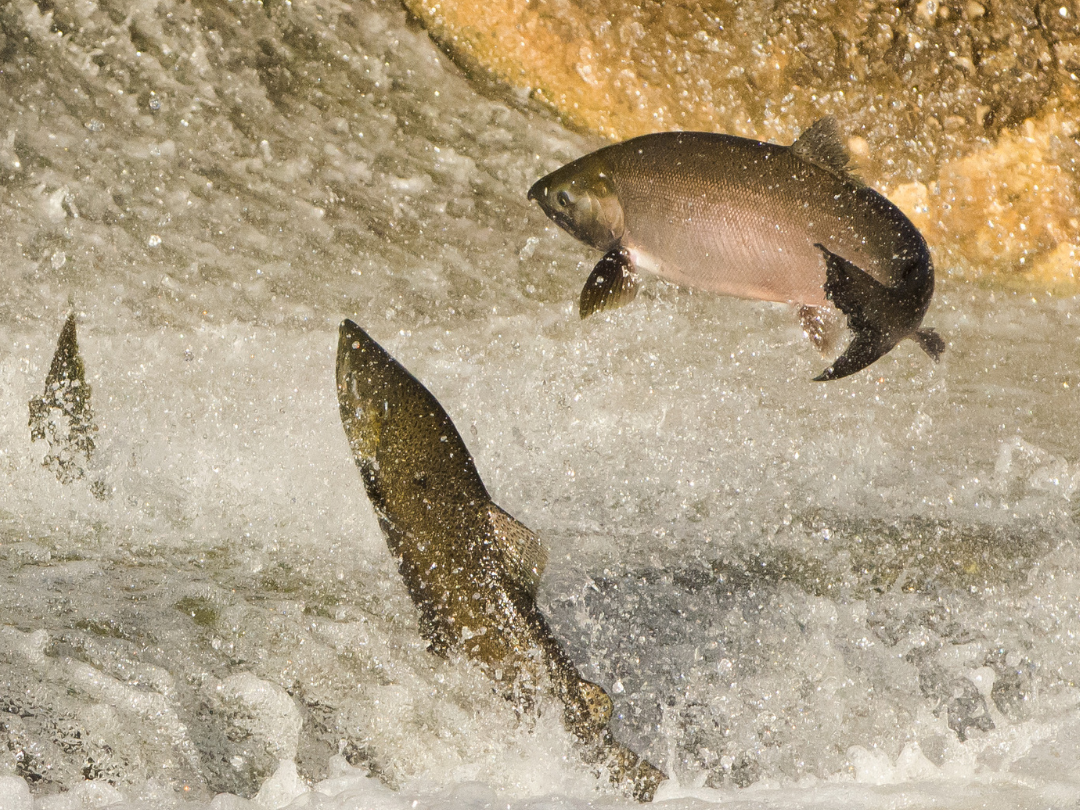
Chinook salmon. Photo credit: Open Source
Friends of the River’s new Lead Scientist, Dr. Devon Pearse, recently provided expert testimony in FOR’s formal “protest” against water transfers from the Yuba River, that shed light on how those transfers, combined with massive pumping operations in the Delta, are harming native fish – especially salmon and steelhead.
Yuba County Water Agency is proposing to extend, by 25 years, its water right to “transfer” up to 200,000 acre-feet of water out of the Yuba River, to willing buyers. This water right is one part of a 2008 agreement (the Yuba Accord) that was intended to support and recover salmonid populations in the Yuba River. Nearly 20 years later, salmon and steelhead have not recovered, and in fact, are doing worse. Friends of the River and our partners have protested the water right extension, because circumstances have changed and science has evolved since 2008.
Yuba River Fish are Salvaged at the Delta Pumps
Central Valley steelhead (Oncorhynchus mykiss) are listed as threatened under the Endangered Species Act. In 2024, state and federal export facilities in the Delta ‘salvaged’ (rescued from being sucked into the pumps) unusually high numbers of young steelhead that were trying to migrate to the ocean. Genetic testing confirmed that most were wild-born fish — not from hatcheries — and that nearly one-third of these salvaged wild fish came from the Yuba River.
This means the Yuba River is a major source of wild fish migrating downstream through the Delta. Unfortunately, it also means that a lot of Yuba River fish are being killed both directly and indirectly by pump operations that export water south. When spring flows are reduced in the Yuba, and throughout the Bay-Delta watershed to store water for later export, those fish face even greater risks. Spring flows are needed to help young salmon and steelhead safely migrate through the Delta towards the ocean, without getting pulled into the pumps or eaten by predatory birds or fish.
Shift in Flow Timing Hurts Salmon and Steelhead
The problem is that dam operations and water diversions have flipped the pattern of seasonal flows on the Yuba River on its head. Historically, spring brought high, cold flows that created nursery habitat for young fish and carried salmon and steelhead out to the ocean. Today, too much of the flow is often held back in the spring and released in the summer — exactly the opposite of what native fish need. The water transfers, and repeated exemptions from its commitment to release water for fish by Yuba Water Agency, make this situation worse.
Dr. Pearse explained it plainly during his testimony at the State Water Board’s hearing on our protest against the Yuba water transfers: reducing spring flows has measurably negative impacts on our native fish, while artificially high summer flows do not have obvious benefits that are helping salmon and steelhead recover, especially not in the Yuba River. The measure of quantity of flow through time, plotted on a graph, is called a hydrograph. This hydrograph shift — from naturally higher spring flows and lower summer flows, to lower spring flows and higher summer flows — is harmful not just to Yuba fish, but to the entire Bay-Delta ecosystem.
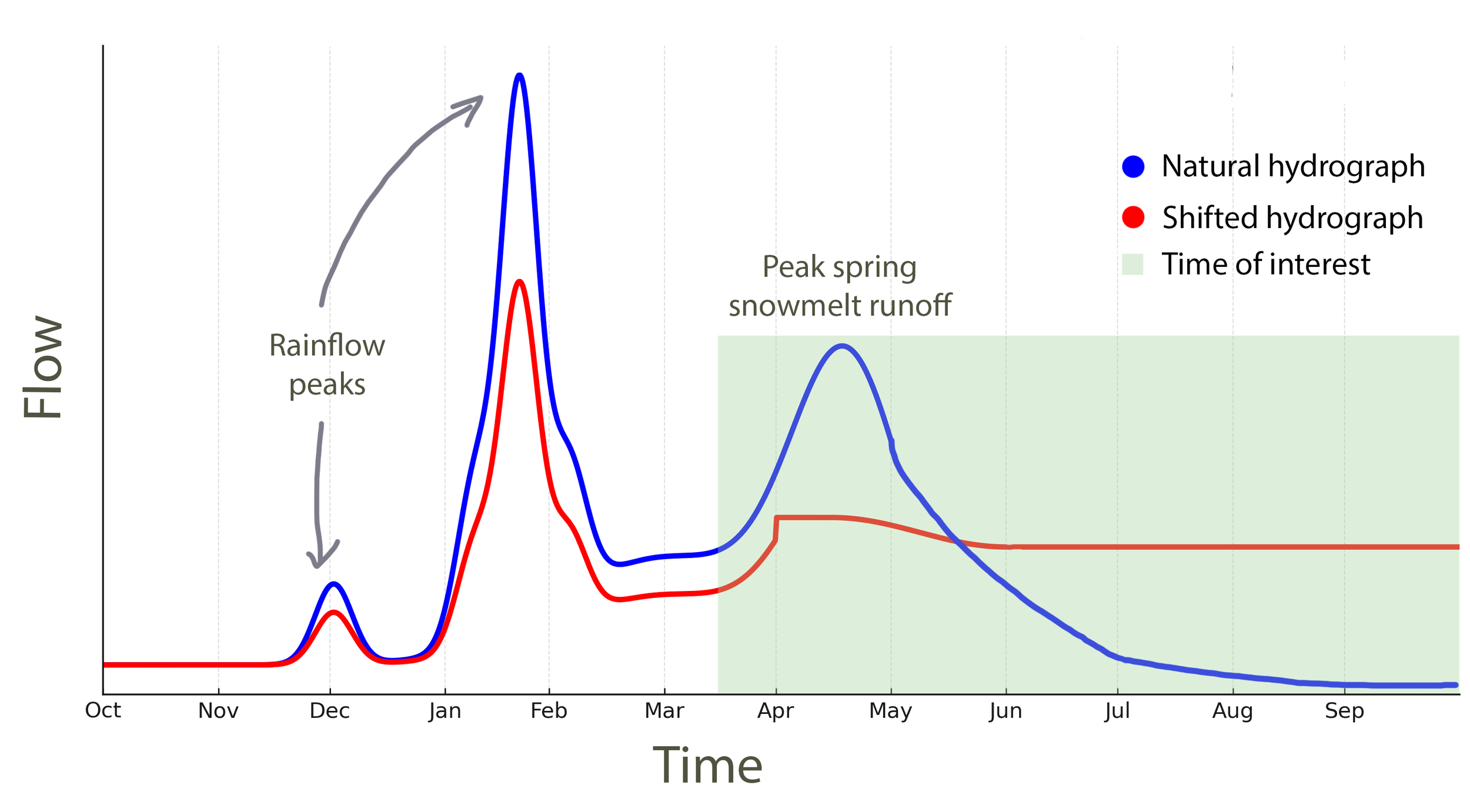
Caption: This is an example hydrograph. Spring through Summer, the period of interest, is shaded in green. The blue line represents a “natural” hydrograph, with high spring flows, largely driven by snowmelt runoff in the Bay-Delta ecosystem. The blue line then steadily decreases through spring to low summer flows. The red line demonstrates the hydrograph shift discussed in this article. The red line shows lower peak flows during spring. This is caused by holding those flows in storage. Then in summer, those flows are released for water deliveries and irrigation. As you can see, the shifted hydrograph has higher summer flows than the natural hydrograph. This is because these flows are shifted from spring to summer.
This is not to say that summer flows are not important. Adequate summer flows are actually critical to maintain Delta water quality and other important factors, especially in our heavily-altered Central Valley landscape. The point is that sacrificing spring flows for summer flows, the latter of which are largely “transferred” and thus do not nourish the Delta ecosystem, is doing much more harm than good.
The Hydrograph Shift is a System-Wide Problem
Yuba Water Agency is not alone in creating this pattern, but it is part of a statewide regime of transfers and exports that has increasingly degraded the Bay-Delta. Each water rights change, transfer, or pumping increase chips away at the natural seasonal rhythms that salmon and steelhead depend on.
The result is clear: declining salmon runs and a collapsing salmon fishery, struggling steelhead populations, toxic algae, and an ecosystem out of balance. Promoting habitat projects as an alternative, as proposed in the backroom Voluntary Agreements, cannot succeed if there are insufficient flows to create or maintain habitat. As Dr. Pearse put it, “water is fish habitat.” And, the science tells us that salmon and steelhead need that water in the spring, as high flows that increase nursery habitat and move young fish safely downstream.
That’s why Friends of the River is working to hold water agencies to account – both on the Yuba River, and in the many other rivers that feed the Bay-Delta Estuary. We are fighting to ensure that flows are restored to scientifically-supported flow patterns that give salmon and steelhead, the entire Bay-Delta ecosystem, and the people across California that depend on it, a fighting chance. Please join us and support this critical work!