
A Tale of Two Water Contract Worlds
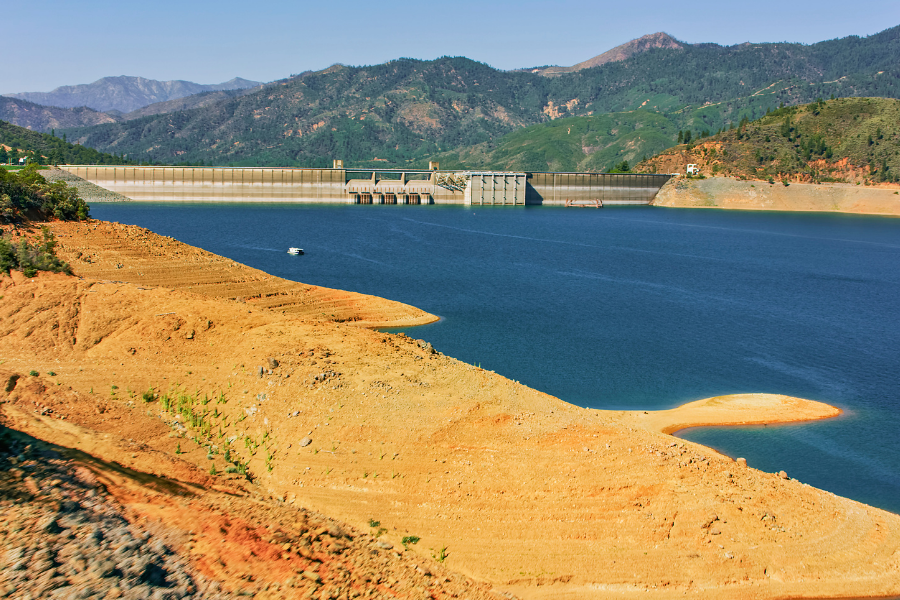
Shasta Dam & Reservoir
Some say that institutional arrangements shape the country we live in, and their disruption can change the of the future. Today, our nation’s President specializes in disruption, but let’s not rule out the Congress and federal courts.
Enter the late U.S. Senator Dianne Feinstein’s Water Infrastructure Improvements for the Nation Act of 2016 (WIIN). It lifted Rep. George Miller’s 1992 Central Valley Project Improvement Act (CVPIA) speed bumps/roadblocks on conversions of Central Valley Project (CVP) “water service” contracts into “water repayment” contracts.

U.S. State Capitol
Please explain, you say. Let’s start. Capturing some of the state’s mightiest rivers (and the Stanislaus), the CVP delivers about 7 million acre-feet of water annually, about one sixth of all the water used in the state. [image of irrigated farms/row crops]
CVP water service contractors’ rates are set to recover the capital and operation & maintenance costs of the U.S. Bureau of Reclamation’s CVP. CVP water service contracts have limited time terms and must be renewed from time to time — potentially exposing the contractor to modifications of terms, reductions in the face value of the contracts, and renewals themselves.
With some CVP contractors routinely not receiving the full contract amounts, Reclamation, albeit with difficulty, could use these contract renewal opportunities to “right-size” the CVP to better reflect the water available to it and consequent better ability to meet the environmental and any revised contract obligations.
Unanimously declaring their water service contracts “anathema!” all CVP contractors, along with Reclamation, undertook the conversions — and drew a couple lawsuits claiming NEPA and ESA deficiencies. The results are starting to come in. On July 1, the Federal District Court in Fresno ruled against the Center for Biological Integrity, Restore the Delta, and Planning and Conservation League objections to the conversions.
Water repayment contractors’ rates are limited to recovering the operation & maintenance costs of the CVP. More importantly, repayment contracts have these key properties that distinguish them from water service contracts:
The contracts are permanent
The face value of the water to be made available in the contract are not subject to reduction
The contracts are not subject to acreage restrictions. Corporate farms will no longer have to go to elaborate arrangements to disguise their size to Reclamation

Of course, Reclamation’s repayment contracts, like its water service contracts, are subject to reduced deliveries if the rains have not been kind to Reclamation this year or its water rights or other permits are limiting. Still, repayment contracts are comparative heaven for Reclamation contractors and one more step to consolidating their control of Reclamation’s capture of key rivers in service to large portions of California’s agricultural sector. The conversions will also have some less direct effects:
The difference between the contract face value and the actual amount of water that nature can provide annually is a powerful advertising tool to push Reclamation to take more water from its environmental obligations and other contractors and deliver the water to irrigators with the best public relations machines and lobbying contacts
The same difference is used to lobby for more dams and canals to deliver more water to the aggrieved irrigators — and presumably at taxpayer expense
Freedom from acreage restrictions will result in the consolidation of land and power in an increasingly small set of irrigators
If the Fresno court’s ruling holds, the spotlight should return to the State Water Resources Control Board’s administration of Reclamation’s water rights. The Board administers those rights and could become the remaining institution with influence over the CVP — potentially setting up a struggle with the Imperial Presidency — if the state has that kind of moxie.