
Nine Million Acre-Feet of New Storage on The Wall: Embarking on a Fool’s Errand?

Anna Caballero, D-Merced
Last year the California legislature passed and Governor Newsom signed SB 72 (Anna Caballero, D-Merced) to require the California Department of Water Resources (DWR) to prepare a new California Water Plan to build 9-million acre-feet of new reservoir storage capacity or 9-million acre-feet of “new” water from storage, increased river diversions, water reclamation, or desalination. (The state’s annual water use is 42-million acre-feet, with the same in total storage capacity).
The Water Plan has been prepared every 5 years since its ill-conceived inception in 1957 and, fortunately, has generally lay harmlessly in DWR’s dusty vaults. However, DWR and the legislature made noises that this time they really mean it. That could mean a subsequent effort to provide the massive taxpayer subsidies necessary to transform California’s rivers into tanks (or bathtub rings) to feed the San Joaquin Valley thirsty agriculture and the state’s urbanizing southland.
It doesn’t have to be that way. So far, the DWR staff running the process (the planning side of DWR, not the side that runs the State Water Project) has been treating their charge in a way that recognizes the complexities and nuances of our current water management, i.e., saying the right things about the 9 million acre-feet being an aspirational target, about the need to look at demand-management oriented solutions as much as new bricks and mortar, and to acknowledge that much of the deficit in California’s water needs is on the instream environmental flow side.
But past history shows us that digging the storage hole deeper (literally and metaphorically) will lead many water users to favor new variations on old themes.
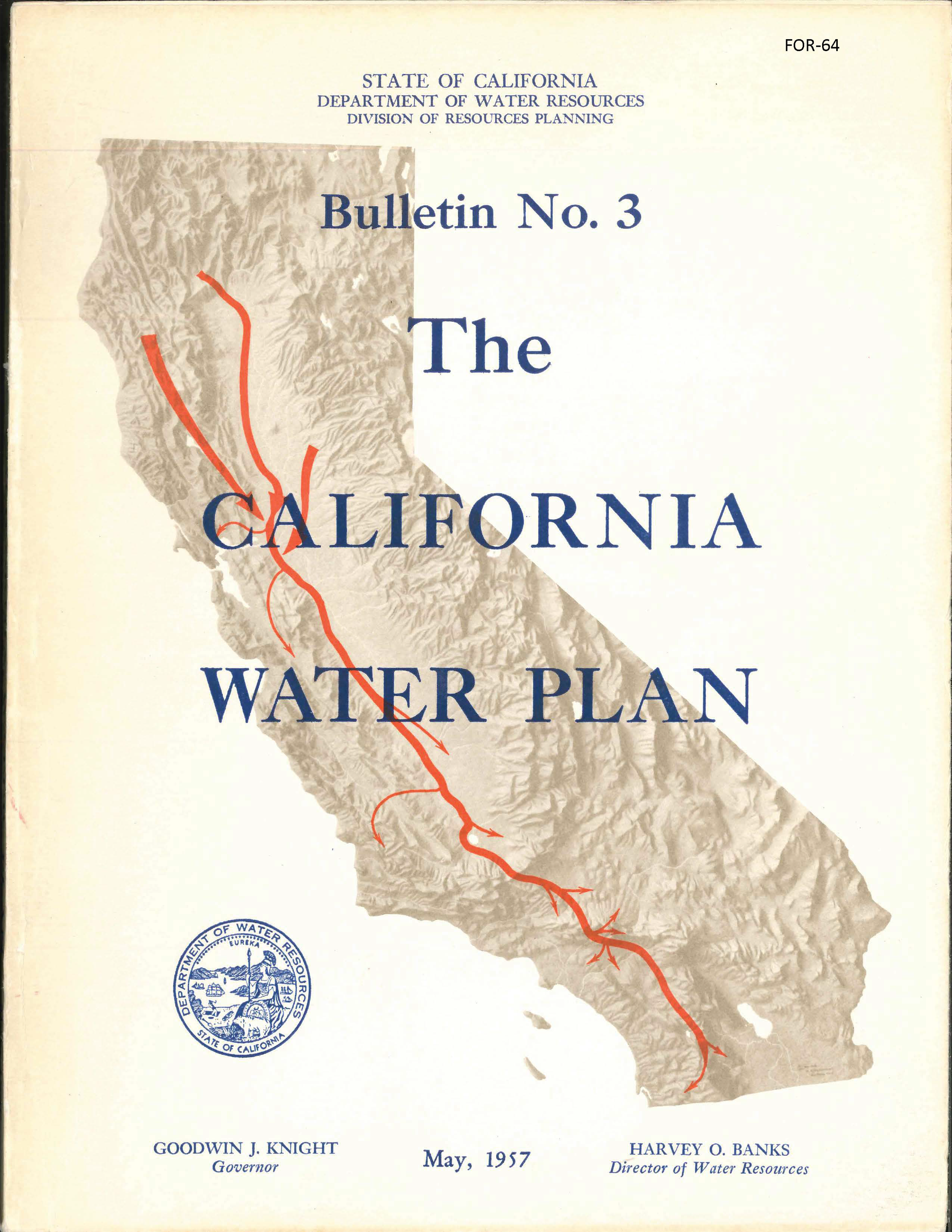
The scale of waterway disruption of the 1957 California Water Plan was breathtaking. Few waterways did not have dams and reservoirs proposed for them and, not unusually, more than one. The export route across the Delta would be extraordinarily busy. Ultimately the “Trans-Delta System” was expected to “transfer some 18,330,000 acre-feet of water per season, on average, across the Delta for conveyance to areas of deficiency…” The grand scale of the transfer projects, called the “California Aqueduct System, adorned the cover of Bulletin #3 depicting the “Ultimate Development and Transfer of Water Under the California Water Plan,” a final solution for California’s rivers.
The 1957 Plan proposed the conversion of California’s north coast rivers into reservoirs. The Plan included an 800,000-acre-foot Coloma dam that would have lain astride the South Fork American River at the takeout for today’s Gorge Run. Ironically, and perhaps a surprise to DWR’s engineers, the plan sparked a backlash. Implementation largely failed, often because of costs. But it also prompted the creation of California’s wild & scenic river system to protect many of the rivers threatened by the Plan.
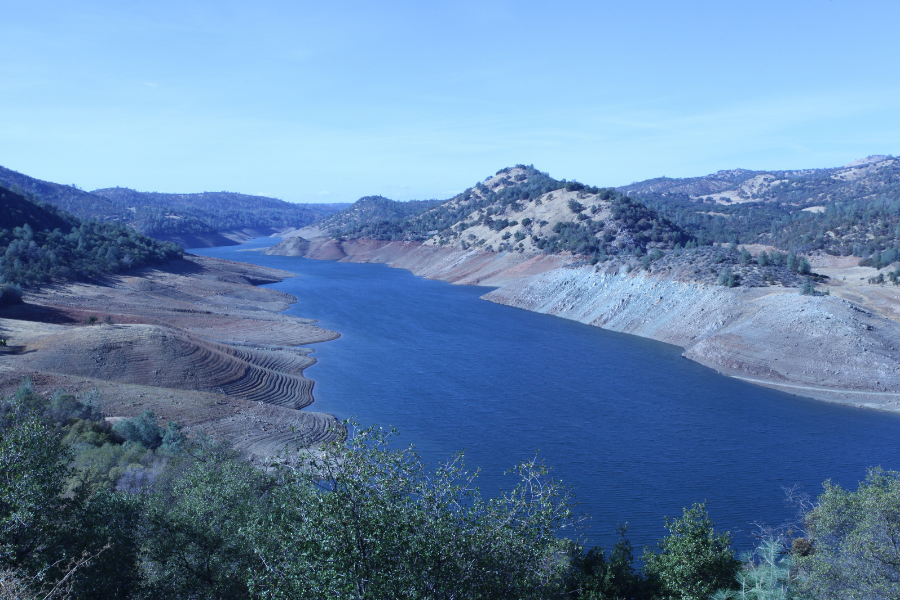
To provide some context, it would take almost 16 of the Kern River’s “Lake” Isabellas or 10 Pine Flat or Folsom Reservoirs to equal 9-million acre-feet of new water storage space. More strikingly, if the goal is to provide 9-million acre-feet of “new” water, if provided from increased water storage capacity and a charitable ten to one storage to yield ratio is assumed, it would only take 160 additional “Lake” Isabellas or 100 new Pine Flat or Folsom Dams.
Yikes! We don’t have that many extra river canyons!
The law of diminishing returns.
The arithmetic can be cruel for new dams on already tapped water sources. The U.S. Bureau of Reclamation is assuming that their proposed Shasta Dam raise can only produce 1 acre-foot of average annual water for every 12 acre-feet of the new storage. The picture that Reclamation paints for their proposed Temperance Flat dam on the San Joaquin River gorge is even worse: a 1 to 17 unfavorable yield to storage profile.
The Sites Reservoir Authority paints a somewhat rosier picture: 1-to 7 yield to storage disadvantage for their off-stream-storage project off the Sacramento River. Importantly, though, they have told the State Water Resources Control Board that they can’t finance the project under the diversion conditions presently offered by the Board.
The question remains, though, are the voters of California willing to invest their dollars to subsidize the dreams (or nightmares or otherwise) of California’s politically powerful irrigators.
The legislature and Governor could have used some remedial education on California’s water issues before being asked to vote on SB 72.
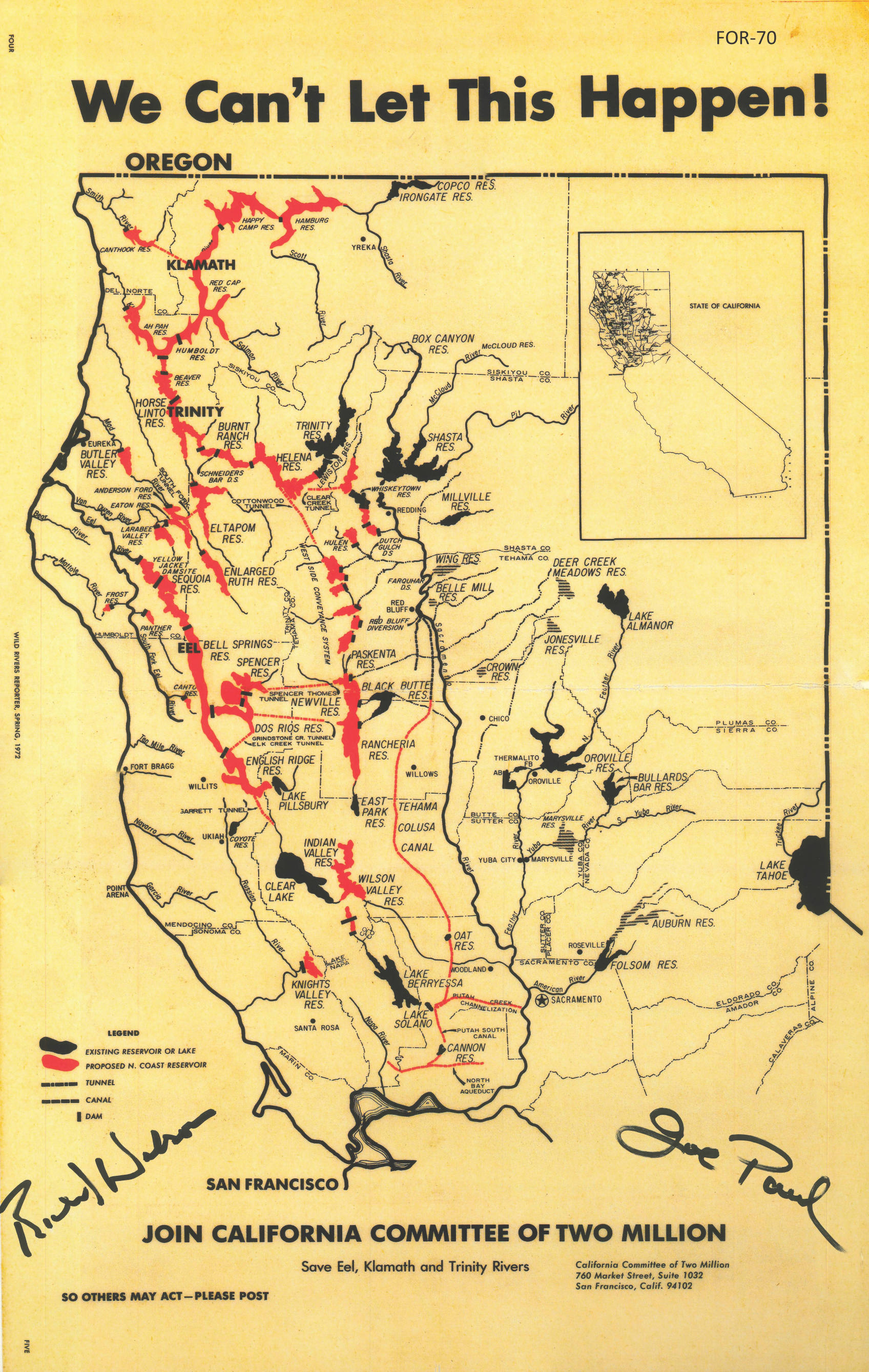
A 1972 map by the California Committee of Two Million depicting the 1957 dream of converting of rivers to reservoirs along the North Coast. The Committee opposed the systematic destruction of North Coast rivers.
It remains unclear what DWR will do with the fool’s errand it is now required by law to undertake. Is it possible that DWR will go down a different road? One that emphasizes aggressive conservation, groundwater remediation, stormwater capture, and land repurposing over more dams on river canyons or siphons from them? One that puts improving flows on our overallocated and sometimes dewatered rivers and streams on the same footing as providing water for cities and agriculture? Friends of the River plans to try to push the Water Plan process down this road as far as we can, while not giving up our day jobs fighting all the bad projects already out there…
DWR does have a nicely polished website proudly taking on the task and emphasizing the 9-million acre-feet of new water Plan target. (See: https://www.californiawaterplan.com/) So at least initially, the Department is emphasizing its continuity with the Department 70 years in its past. For more on how bad things could get, see our previous blog: Plotting the Return to the Old Dam-Building Era (Feb 2026).
One can only hope that more arithmetically honest voices can emerge in the next State Administration.
Fool’s errands, after all, are a waste of time and resources.