
10 years after dam removal, Carmel River still faces challenges
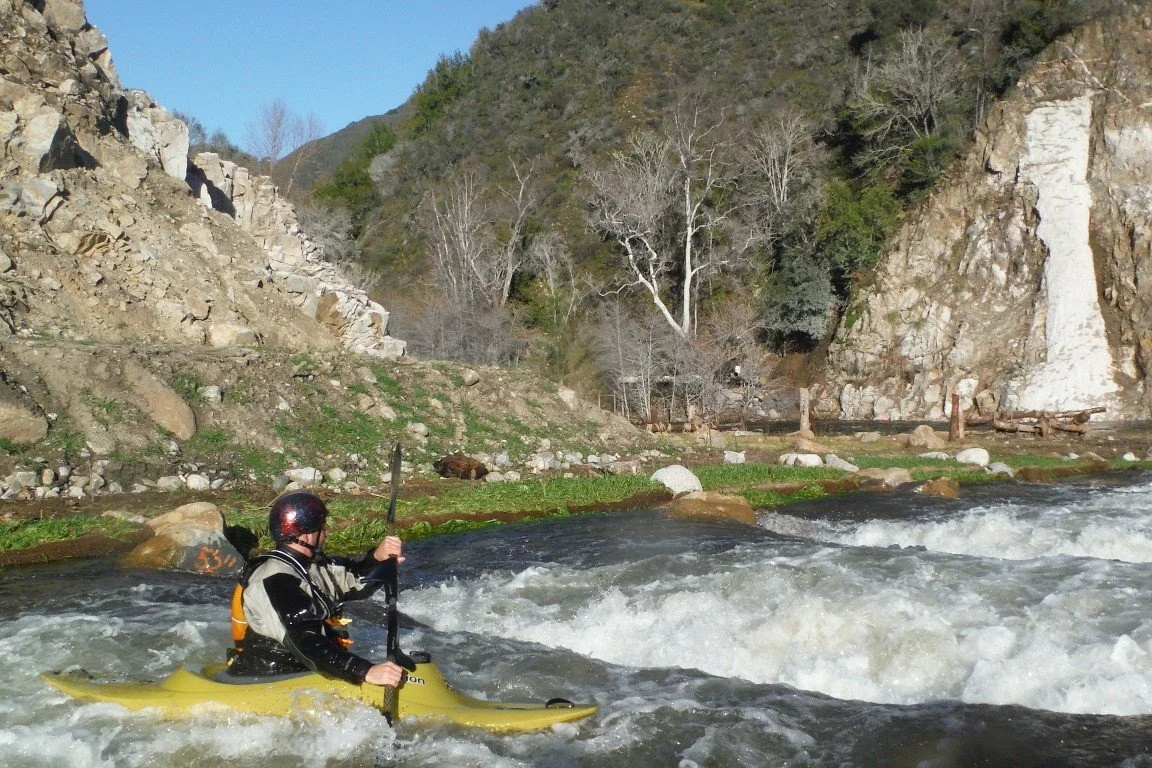
Kayaking through the rerouted channel and old dam site, with the old dam abutment visible on the right. Photo by: https://www.cacreeks.com/carmel3.htm
Despite having been freed of San Clemente Dam in 2015, the Carmel River faces continued challenges, as was highlighted in a November 5th water rights order hearing of the State Water Resources Control Board. Unlike the complex statewide water projects flowing through California’s Central Valley, many coastal areas rely on local supply, often from a single river. Such is the case of the Carmel River, which serves the water needs of the entire Monterey Peninsula. This focused demand for Carmel River water is of particular concern for the population of steelhead that depends on it, and for the South-Central California Coast steelhead recovery group.
In the decade plus since San Clemente Dam was removed, the river section that was inundated by the reservoir has been reborn. Despite the complexity of this dam removal and river reroute it has reestablished migratory connectivity for the first time in more than 100 years—and not just for fish! It is now possible to kayak from just below Los Padres Dam down ~6 miles of wilderness river and through the old dam site and into Carmel Valley below. Initially, the post dam-removal restoration created a perfectly engineered channel with 42 step-pools, a kayakers delight. This quickly changed when multiple storms of 10-year and 30-year significance hit in February and March 2017 and the resulting flow events rearranged this carefully constructed reroute channel into something that looked much more like a natural river channel (as seen in this video, with the dam removal section starting at 3:00). Today, the riparian areas in the former dam reach continue to recover, a powerful demonstration of the resilience of nature.
Nonetheless, continued vigilance on environmental protections is needed in the face of the growing demand for water. The Carmel River has not been illegally over-drafted in the past five years, due to reduced water withdrawls in response to a Cease-and-Desist Order. But, as Friends of the River’s Lead Scientist Devon Pearse commented in the Nov 5th hearing, this is a very short time frame on which to base regulatory changes. Water use from the Carmel River should be based on strong science and monitoring, continued progress on groundwater recharge targets, robust minimum in-stream flow requirements, and metrics of success for steelhead recovery.
New research has further demonstrated the importance of connected flows on the Carmel River by showing how extensively juvenile steelhead migrate up and down the river in the first few months of their lives. The work, led by Dr. Haley Ohms of Trout Unlimited and coauthored by Pearse and UC Santa Cruz and NOAA Fisheries colleagues, used genetic data to identify siblings separated by up to 40 river kms— all the way from Los Padres Dam to the sea. These results show that maintaining freshwater flow in the river—not allowing it to become dry and disconnected as often happens in summers—is critical for steelhead populations and for the entire Carmel River ecosystem.
The Carmel River serves as a reminder that dam removal is not the end of the story. Regardless of the decision the Board makes in this case, the river will always require continued monitoring and advocacy to ensure that all aspects of watershed health are adequately maintained, especially flow.