State Rejects Federal Temperature plan for Sacramento River Salmon
Reclamation can’t protect salmon – but can deliver more water to ag water districts
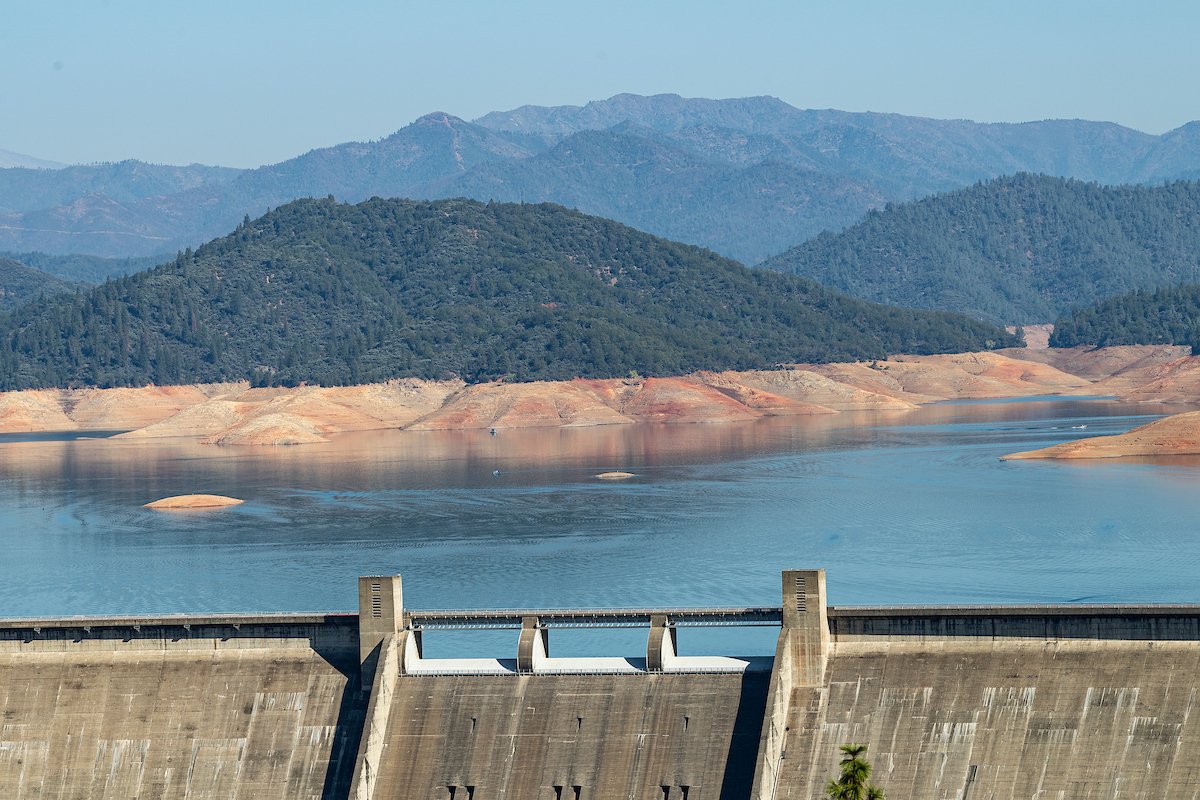
Shasta Dam and its bathtub ring in 2022. Credit: CA DWR.
By Devon Pearse, Lead Scientist
The war between California and the federal government over the fate of our rivers and salmon runs ratcheted up another notch this month when state regulators rejected the Bureau of Reclamation’s temperature management plan for the Sacramento River.
Reclamation, which operates the Central Valley Project’s massive Shasta Dam on the upper Sacramento River and water export pumps in the Delta, had already been violating its Endangered Species Act permit terms this spring by exceeding its take of endangered winter-run Chinook salmon, steelhead, and green sturgeon and failing to provide adequate pulse flows for fish migration. Nonetheless, in May the agency announced yet another increase in deliveries from Shasta Dam to CVP ag contractors south of the Delta – a move calculated to maximize profits for irrigators at the expense of providing critical habitat for endangered native fish species. The move was yet another effect of President Trump’s executive order to, in his words, ‘put people over fish’ and stop radical environmentalism.
Every year, Reclamation is required to make decisions and submit a plan to manage the portion of California’s water that it can hold in the state’s largest reservoir, Lake Shasta. This year they have once again made poor choices in doing so. Reclamation announced the initial 2026 water allocations in February, and then twice, first in March and again in May, increased allocations to CVP contractors south of the Delta. All CVP municipal and industrial and public health and safety needs were already being fully met, so the additional deliveries were solely intended to benefit South-of-Delta contractors.
The final straw came at the end of May when Reclamation submitted a final Sacramento River temperature management plan to the State Water Resources Control Board that would result in higher levels of mortality for salmonids from increased temperatures and dewatering of salmon redds (nests). The Board correctly rejected Reclamation’s plan as non-compliant with both the ESA permit conditions and the state requirements for temperature control in the Sacramento River below Shasta Dam – although it is unclear what action the Board will take if Reclamation proceeds as planned.
Together these announcements made one thing is clear—Reclamation is not making decisions based on the best available science or established environmental policy.
The best available science supports more water in the river
While this has undoubtably been a challenging year given the low snowpack and warm March, it was not a critical water year, meaning there should have been great opportunities to support environmental benefits in water management. FOR and our partner organizations argued for applying the best available science to produce large potential survival benefits for migrating juvenile salmon by releasing multiple well timed ‘pulse flows’ in the Spring months to help push the baby salmon quickly downstream.
Instead, Reclamation released a single, tiny, pulse flow (~35 TAF), primarily to support outmigration of hatchery fish released at the same time. Subsequent analysis (Figure 1) showed that adding a second pulse flow with a combined water cost of <100 TAF could have more than doubled outmigration survival by both hatchery and wild juvenile salmon. Unfortunately, Reclamation chose not to follow that science.
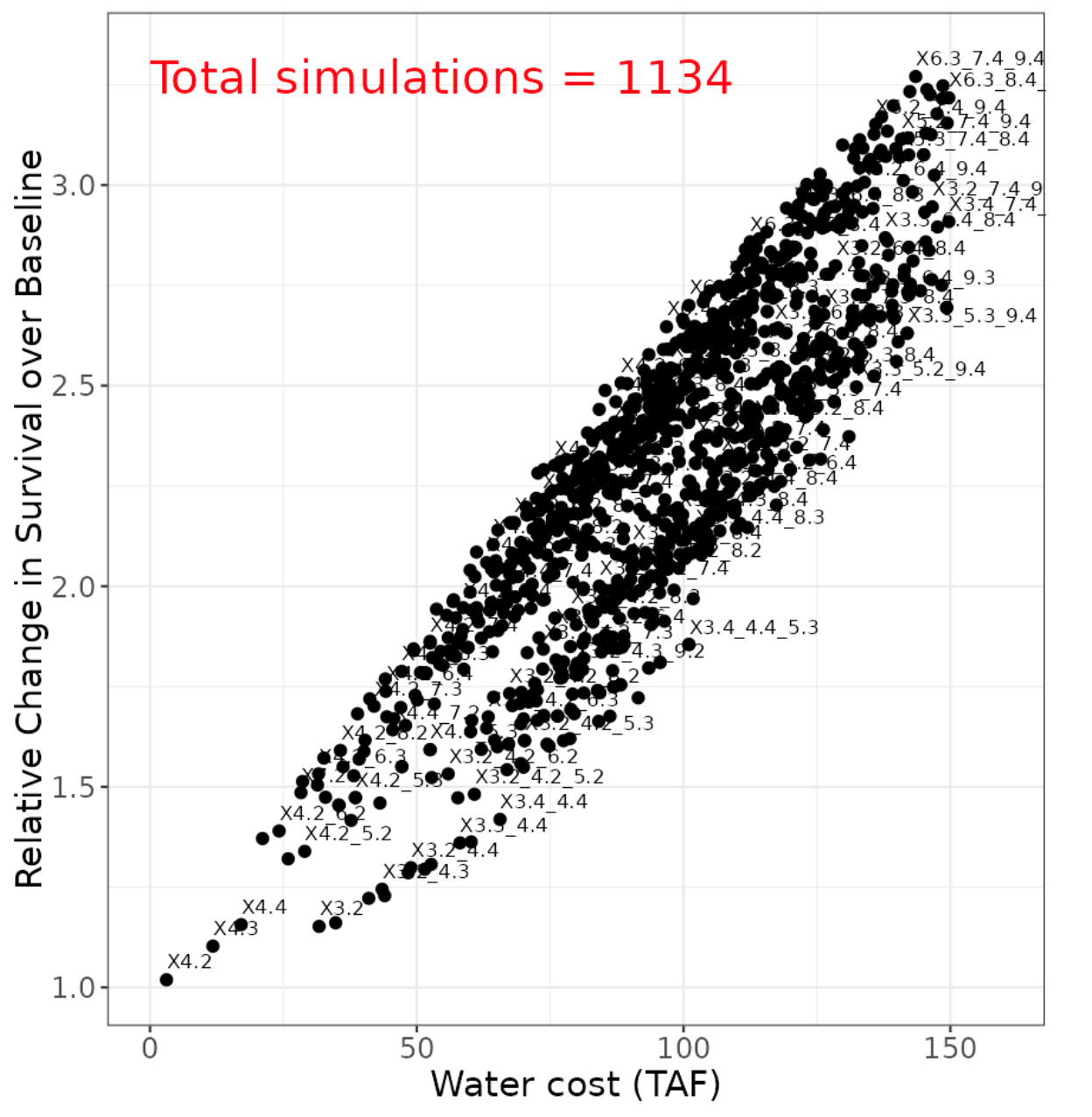
Figure 1: Potential relative increases in survival from up to three pulse flows in April-May 2026 based on modeling from the NOAA Southwest Fisheries Science Center. You can see and ‘play’ with the model yourself HERE.
Science in hot water
As with the pulse flow science, Reclamation also disregarded temperature analyses showing potentially high mortality of winter-run Chinook salmon eggs during the hot summer months when they are incubating in the cold water flowing out of Shasta Dam (Figure 2)
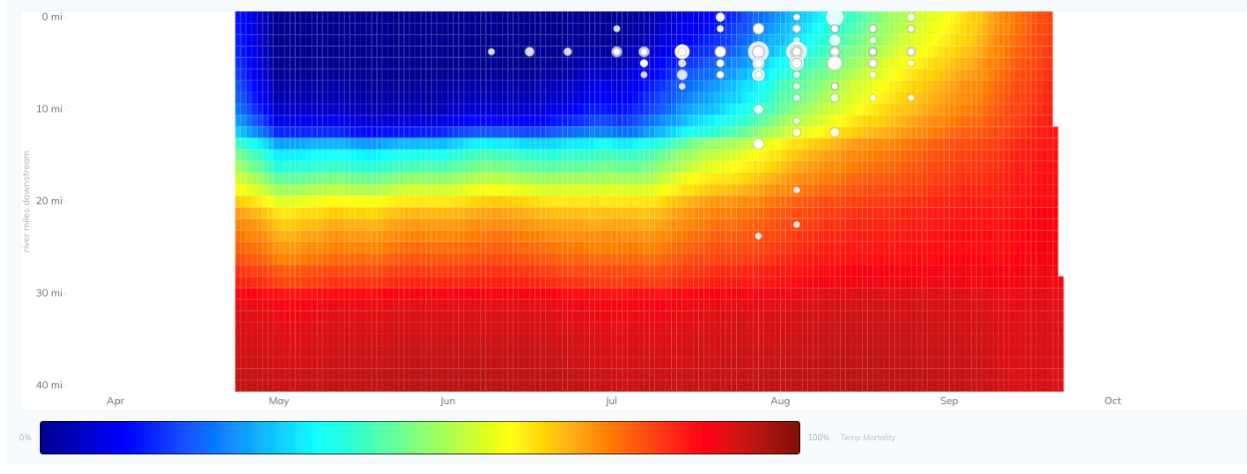
Figure 2: Potential for high mortality of wild winter-run Chinook salmon eggs, especially late in the season. X-axis, months in 2026. Y-axis, distance downstream from Keswick Dam. Temperature Dependent Mortality landscape modeled by the NOAA Southwest Fisheries Science Center, April 2026. Colors indicate egg mortality from 0% (blue) to 100% (red); white circles mark redd locations in 2025.
Once hatched the juveniles also require continuous access to cold water habitat as they develop and migrate to the ocean. There’s also evidence that temperatures for salmon eggs in the wild need to be no more than 53.5 F, or 12 C, a lower threshold than previously recognized (Martin et al. 2017).
To keep fish below Shasta Dam in ‘good condition’—not just ‘not extinct’— Reclamation must provide flows to the river, including the multiple pulses in the spring, that mimic the functional parts of the natural hydrograph and critical needs of salmon. This will create multiple benefits to support the ecosystems of the San Francisco Bay Delta for listed species and the commercial and recreational fisheries and communities of Californians who want these activities to continue into the future. Expect to hear more from FOR in coming days on the specific actions we are taking to force Reclamation to comply with its federal ESA and state temperature requirements.